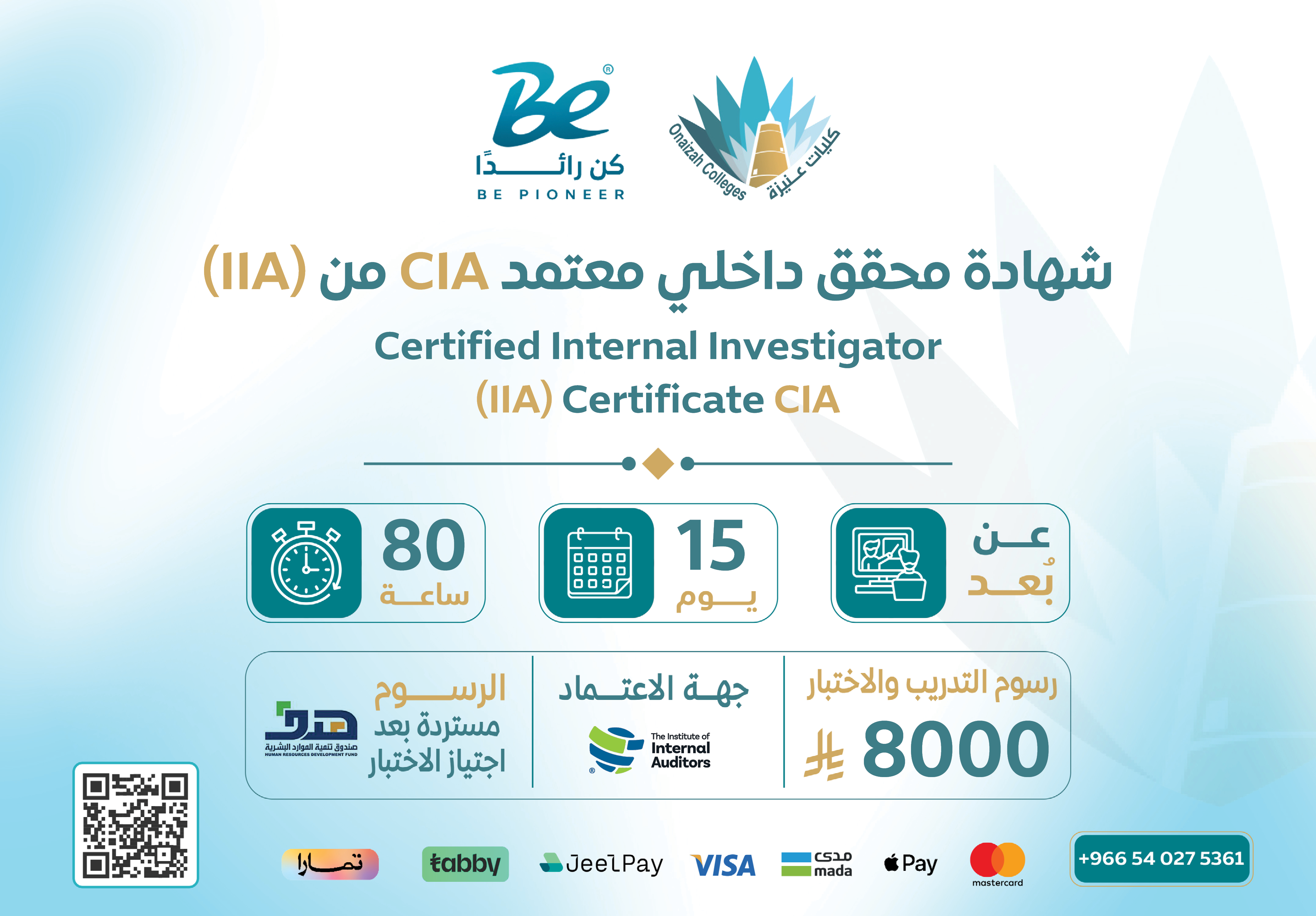
In a world increasingly dependent on transparency and sound governance within organizations, internal audit has become a pivotal function that no organization can do without — whether it's a large corporation, a government entity, or even a mid-sized business. As the importance of this function has grown, so has the need for a unified professional standard that sets competent auditors apart from the rest. This is where the Certified Internal Auditor (CIA) certificate, issued by the Institute of Internal Auditors (IIA), comes in — widely regarded as one of the most prestigious and internationally recognized professional credentials in the field of internal audit.
This article covers everything related to the CIA certificate, its importance in the job market, and the difference it makes in the career of any professional working in audit and oversight, along with how to obtain it through be pioneer, a platform specialized in offering training programs and accredited professional certificates across various financial, managerial, and oversight fields.
What Is the Certified Internal Auditor (CIA) Certificate?
The CIA certificate — short for "Certified Internal Auditor" — is the only globally recognized professional certification dedicated specifically to the internal audit profession. It is issued by the Institute of Internal Auditors (IIA), the global reference authority in this specialty for decades. This certificate grants its holder broad professional recognition for their ability to assess internal control systems, manage risk, and evaluate corporate governance, all in line with the highest internationally accredited professional standards.
Internal audit differs from many other financial specialties in that it isn't limited to reviewing figures and financial statements alone — it extends to assessing the efficiency of operational processes, the degree of adherence to internal policies and procedures, and identifying weaknesses in control systems before they turn into real risks that threaten the organization's continuity. This is where the true value of the CIA certificate comes from: it qualifies its holder to handle this wide range of responsibilities with a clear, methodical, and professional approach.
Why Does the Institute of Internal Auditors (IIA) Hold Such Global Standing?
The Institute of Internal Auditors (IIA) is considered the world's leading authority in setting professional standards for internal audit. It is the institute that established and developed the International Professional Practices Framework (IPPF), which the vast majority of organizations and companies around the world rely on to build and evaluate their internal audit departments. Because the CIA certificate is issued directly by this institute, it carries significant professional weight that many other certificates in this field simply don't have.
This direct connection between the CIA certificate and the world's leading authority in internal audit is what makes it the top choice for many aspiring auditors. It's not just about earning an official document — it's about joining a professional community recognized across the world, opening up broad opportunities for the certificate holder to work in diverse professional environments and international organizations.
The Importance of CIA Amid the Evolving Concept of Corporate Governance
Recent years have seen a clear shift in how organizations view the internal audit function. It's no longer seen as a traditional oversight role whose sole purpose is detecting errors after the fact — it has become a strategic partner to senior management in strengthening corporate governance, proactively managing risk, and continuously improving the efficiency of internal operations. This shift in the concept of internal audit has made it essential for auditors to possess skills that go beyond traditional accounting review, extending to strategic thinking, the ability to communicate effectively with different departments, and a deep understanding of the business environment and the risks tied to it.
The CIA certificate prepares its holder for this broader, more strategic role, equipping them with a comprehensive knowledge framework covering the fundamentals of internal audit, risk and control management, the practice of internal audit, and a deep understanding of the business environment and corporate governance. This is what genuinely qualifies a certificate holder to contribute to the development of the organization they work for, rather than simply evaluating its performance after the fact.
The Difference Between CIA and Other Financial Professional Certificates
Many professionals working in the finance and accounting field find themselves facing multiple options when thinking about developing their career path. Some lean toward general accounting certificates, others prefer certificates specialized in management or financial accounting, while others specifically head toward the CIA certificate as the best option for someone who wants to specialize precisely in internal audit, risk management, and governance.
The fundamental difference lies in the fact that many general accounting certificates focus primarily on financial reporting, tax compliance, and accounting compliance, while the CIA certificate focuses on evaluating the effectiveness of internal control systems as a whole — covering operational and strategic dimensions alongside financial ones. This broader scope of coverage gives the CIA certificate special value for anyone aspiring to hold leadership positions in internal audit, risk, or governance departments within large organizations.
The Role of Specialized Training Platforms in Preparing for the CIA Certificate
Passing the CIA certificate exams requires methodical, intensive preparation, given the wide scope of material the certificate covers and its professional depth. This is where specialized training platforms come in — ones that genuinely understand the nature of this specific certificate and design their training programs to match its precise requirements, rather than offering generic content that doesn't account for the particular demands of internal audit.
When designing its CIA certificate program, be pioneer makes a point of working with trainers who have genuine hands-on experience in internal audit, not just theoretical knowledge of the exam content. This approach ensures that trainees come away with a clear, practical understanding of how to apply internal audit principles to real-world organizational settings, not just the ability to pass a theoretical exam.
How to Obtain the CIA Certificate Through be pioneer
The be pioneer platform follows a clear, organized path for anyone who wants to prepare for the Certified Internal Auditor (CIA) certificate. This path can be summarized in several consecutive stages:
Stage One: Registering for the Training Program The journey begins by visiting the be pioneer platform and registering for the CIA certificate preparation program, where all the details related to the study method, the suggested timeline, and communication with trainers specialized in internal audit and risk management are clearly explained.
Stage Two: Intensive Training on the Exam Parts After registration, the trainee goes through an intensive training track covering the core material included in the CIA certificate, supervised by trainers with extensive hands-on experience in internal audit and governance, using an approach focused on linking theoretical concepts to real, practical cases and scenarios.
Stage Three: Assessment and Preparation for the Institute's Exams The preparation stages follow a continuous assessment process that ensures trainees genuinely grasp the core concepts, alongside training on sample exams similar to those offered by the Institute of Internal Auditors (IIA), which builds confidence and readiness for the official exams.
Stage Four: Sitting for the Certificate Exams and Obtaining Accreditation After completing preparation, the candidate sits for the official CIA certificate exams at the institute. Upon passing successfully, they receive full professional accreditation, which they can add to their resume and professional profile, boosting their chances of promotion or landing new career opportunities in audit, oversight, and governance.
This step-by-step approach adopted by be pioneer turns the CIA preparation journey into a well-organized, clearly defined experience, rather than the disorganization many candidates face when preparing on their own without guidance.
The Impact of CIA on the Career Path of Its Holders
The impact of earning the CIA certificate isn't limited to adding a new professional credential to a resume — it extends to strengthening its holder's standing within their organization and in the job market at large. Many large organizations and multinational companies now consider the CIA certificate a core criterion when evaluating candidates for leadership positions in internal audit departments, given what it represents as a guarantee of a unified, internationally recognized professional standard.
CIA certificate holders also tend to enjoy greater trust from audit committees and boards of directors, as they possess a deep understanding of governance and risk management frameworks, and the ability to offer strategic insights that go beyond simply reporting errors and violations. This is directly reflected in promotion opportunities within an organization, as well as negotiating power when applying for new career opportunities, whether in the local market or in international work environments.
The CIA Certificate Amid Digital Transformation and Evolving Audit Tools
Internal audit is no longer immune to the wave of digital transformation sweeping across various professional fields. In fact, it has become one of the fields most reliant on advanced analytical tools and data analysis systems to identify risks and detect unusual patterns in financial and operational processes. For this reason, CIA certificate content keeps pace with this development by including concepts related to modern audit techniques, data analytics, and the role of technology in enhancing the effectiveness of internal audit operations.
This approach makes CIA certificate holders better equipped to adapt to modern audit tools, shifting from a traditional approach based on manual review to a more proactive approach that relies on big data analysis and predicting risks before they occur — enhancing the certificate holder's professional value within any organization they work for.
The Importance of CIA for Those Working in the Government and Semi-Government Sectors
The importance of the CIA certificate isn't limited to the private sector — it also extends to professionals working in government and semi-government institutions, which have been placing increasing focus on strengthening internal control systems and corporate governance as part of their push toward transparency and efficiency in managing public resources. An internal auditor holding the CIA certificate has the tools needed to assess how efficiently government systems manage resources, adhere to policies and procedures, and identify gaps that could affect overall institutional performance.
This makes the CIA certificate a strategic choice for anyone working in, or aspiring to work in, internal audit units within government bodies or public institutions, as it provides a unified professional framework aligned with international best practices in the field, rather than relying on traditional oversight methods that may not keep pace with modern developments in this specialty.
Practical Tips for Successfully Preparing for the CIA Certificate Exams
Before starting the journey of preparing for the CIA certificate, whether independently or through a specialized training program, it's worth considering a few practical points that contribute to better results:
- Set a realistic timeline: Given the wide scope of material covered by the CIA certificate, establishing a clear, organized preparation schedule helps avoid feeling overwhelmed or scattered, and ensures balanced coverage of all exam parts.
- Rely on trustworthy, up-to-date sources: Internal audit standards and practices are constantly evolving, so it's important to rely on updated training material that reflects the latest developments in the field, rather than outdated sources that may not reflect current standards.
- Focus on understanding rather than memorization: Given the applied nature of the internal audit profession, focusing on understanding concepts and how to apply them in practical scenarios is far more valuable than pure theoretical memorization, which may not hold up against the exam's applied questions.
- Practice on simulated exam samples: Practicing on sample questions similar to those offered by the Institute of Internal Auditors (IIA) helps build confidence and familiarity with the nature and phrasing of the questions before sitting for the actual exam.
- Take advantage of specialized trainers' expertise: Enrolling in a guided training program with trainers who have genuine hands-on experience in internal audit saves significant time and effort compared to unguided self-preparation.
These practical steps make the CIA preparation journey a more organized and effective experience, far removed from the disorganization many candidates face when relying solely on self-preparation without specialized professional guidance.
The Connection Between CIA and a Culture of Enterprise Risk Management
One of the factors that adds to the CIA certificate's value in today's professional market is its close connection to a culture of enterprise risk management — a culture that has become a cornerstone of organizational stability and long-term business continuity. An internal auditor holding the CIA certificate doesn't just play the role of an observer who detects errors after they happen; they become a genuine partner in identifying potential risks before they turn into real crises, through periodic, methodical assessment of internal control systems across the organization's various departments.
This proactive role requires the auditor to have a deep understanding of the nature of the organization's business, the industry it operates in, and the external factors that could affect its stability — all of which the CIA certificate provides through comprehensive content that links theoretical risk management principles to their practical application across different work environments. As modern business environments grow more complex, and as organizations face an increasingly diverse range of risks — whether operational, financial, technological, or even related to institutional reputation — the need for well-rounded, qualified internal auditors grows too, which is exactly what the CIA certificate aims to deliver.
How Does CIA Reflect on the Credibility of Internal Audit Reports?
One of the core elements that distinguishes an internal auditor's work is the credibility of the reports they prepare and submit to senior management and audit committees. The more solid and internationally recognized an auditor's professional background is, the greater the trust stakeholders place in their conclusions and recommendations. This is precisely where the value of the CIA certificate shows up — it doesn't just grant its holder theoretical knowledge, but also binds them to a strict code of professional ethics set by the Institute of Internal Auditors (IIA), ensuring their work is grounded in objectivity, independence, and integrity.
This ethical commitment tied to the CIA certificate makes reports produced by certified auditors more readily accepted and trusted by both boards of directors and external regulatory bodies alike, since they come from a professional held to clear, monitored professional and ethical standards — not simply a personal opinion or an assessment lacking a sound, accredited methodology.
Amid the growing global push toward transparency and sound governance within organizations, the Certified Internal Auditor (CIA) certificate, issued by the Institute of Internal Auditors (IIA), stands out as one of the most important career paths any professional in audit, oversight, and risk can pursue to strengthen their professional standing and career opportunities. This certificate doesn't just grant its holder an internationally recognized official document — it equips them with a comprehensive knowledge and professional framework that qualifies them to make a real contribution to the organizations they work for.
be pioneer offers a trusted, clear path for anyone seeking to prepare for the CIA certificate, with organized training stages that start with registration and end with full readiness to confidently sit for the institute's exams — opening new career horizons for professionals and aspiring candidates in internal audit, governance, and risk management. Whether you work in the private or government sector, whether you're at the start of your career or looking to advance toward higher leadership positions, investing in this prestigious certificate remains a strategic step whose positive effects will carry through your career for many years to come.