General Description
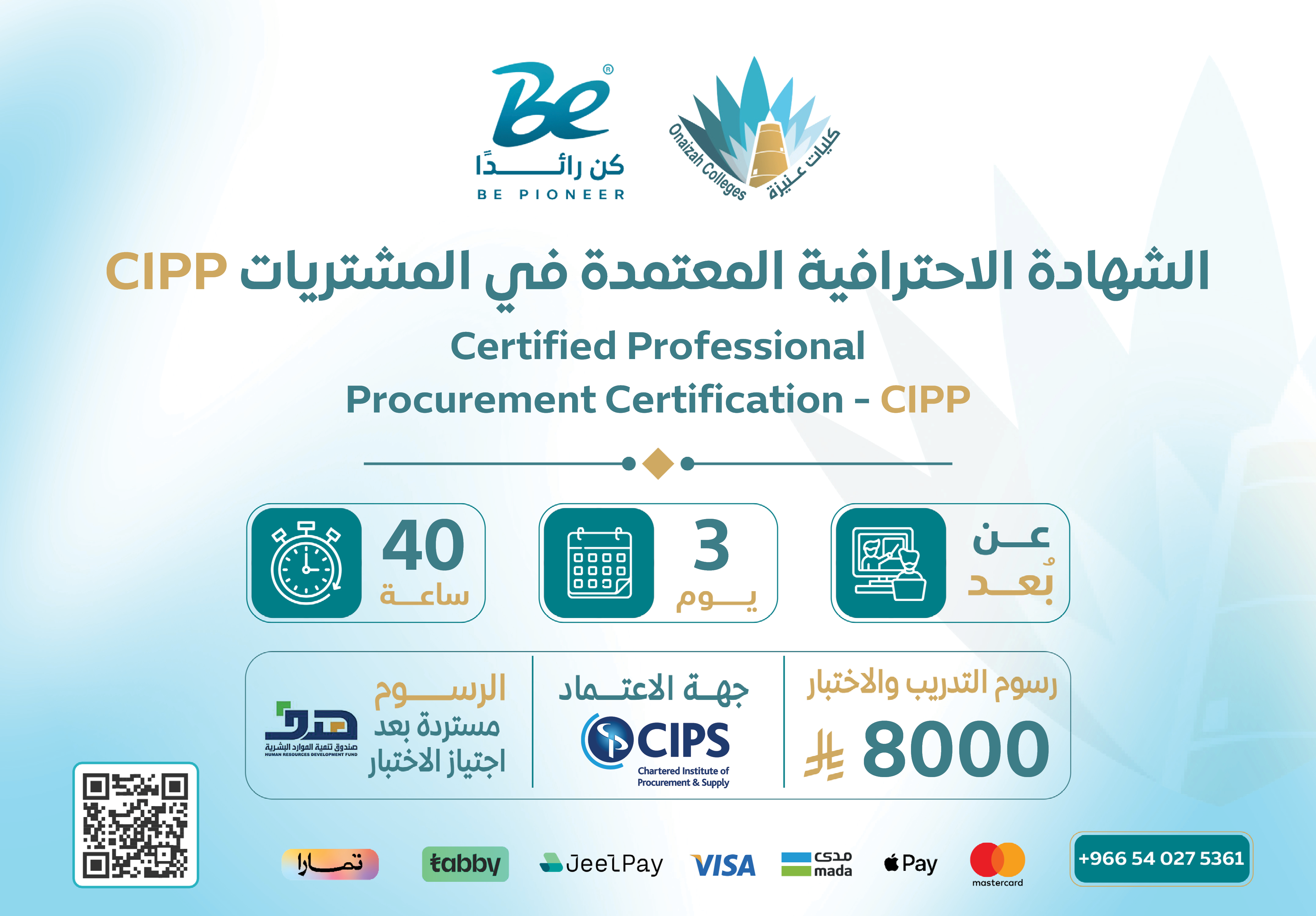
The Certified International Procurement Professional (CIPP) is a specialized professional certification designed to qualify professionals to work in procurement and supply chain management according to global best practices. This certification provides participants with a solid foundation in strategic procurement concepts, from planning and market analysis, through negotiation and contract management, to supplier evaluation and cost analysis.
The certification focuses on enabling participants to understand the fundamental difference between "strategic procurement" and "traditional purchasing," and equips them with the skills needed to deliver real value to their organizations through cost reduction, improved supplier quality, and risk management. The certification also covers the latest practices in e-procurement and sustainable (green) procurement.
This course is offered through the Be Pioneer platform for professional certifications, part of the Open Training Platform and Professional Certifications at Unaizah Colleges, where participants receive comprehensive preparation to understand certification requirements and confidently pass the exam, becoming professional procurement specialists capable of achieving excellence in modern work environments.
The Goals
-
Provide participants with a strong foundation in global and strategic procurement concepts and their application in various work environments .
-
Enable participants to understand the difference between Procurement and Purchasing and the role of each in the organization .
-
Develop skills in procurement planning, contract management, supplier evaluation, and cost analysis.
-
Prepare participants to apply sustainable (Green Procurement) and ethical procurement practices in organizations .
-
Prepare participants to successfully pass the CIPP certification exam.
Target Auidence
-
Procurement and supply chain professionals seeking to develop their skills and obtain a certified professional credential.
-
Procurement, contract, and supplier managers in government and private sectors.
-
Logistics and supply chain operations officers who deal with procurement in their daily work.
-
Graduates of business administration, engineering, and logistics colleges seeking specialization in procurement.
-
Entrepreneurs and business owners who need to better understand their procurement management.
-
Anyone seeking to build a career path in procurement and supply chain management.
The Features
-
Recognized professional certification in procurement and supply chain management.
-
Comprehensive coverage of the complete procurement cycle from planning to contract management and supplier evaluation .
-
Focus on the practical side through tools and strategies applicable immediately in the workplace.
-
Development of negotiation skills, supplier relationship management, and financial analysis of procurement.
-
Coverage of latest practices such as e-procurement and sustainable procurement .
-
Complete exam preparation through the Kun Ra'edan platform for professional certifications, part of Unaizah Colleges.
Topics
-
Procure to Pay (P2P): P2P definition, process flow, automation of P2P, purchasing methods, cross-functional purchasing, centralized vs decentralized purchasing .
-
E-commerce & E-procurement: E-procurement value chain, e-procurement tools, evolution of e-procurement models, benefits and disadvantages .
-
Sourcing & Supplier Management: Sourcing process, types of sources of supply, market conditions analysis, Make vs Buy analysis, types of leasing, solicitation .
-
Sustainable Procurement: Green procurement concept, scope and benefits, implementing green procurement policy, creating a green procurement program .
-
Supplier Evaluation: Supplier assessments, supplier approvals, evaluation methods .
-
Global Purchasing: Why buy global, sources of information for overseas suppliers, overcoming global sourcing challenges, true cost of global buying, factors of success .
-
Negotiations: Approach to negotiation, content of negotiation, factors in negotiation, negotiation process, negotiation in relationships, negotiation ethics .
-
Contract Management: Contract management basics, contract clauses, performance management, completing the procurement cycle.
-
Procurement Performance Measurement: Key Performance Indicators (KPIs) in procurement, supplier efficiency measurement, continuous performance improvement.
Learning outcomes
-
Successfully pass the CIPP certification exam.
-
Ability to apply global and strategic procurement concepts in the work environment.
-
Ability to distinguish between procurement and purchasing and apply each in the appropriate context.
-
Ability to manage the complete procurement cycle from planning to contract closing .
-
Ability to effectively evaluate, select, and manage suppliers.
-
Ability to apply sustainable and ethical procurement practices.
-
Ability to use e-procurement tools to improve efficiency .
-
Qualification for procurement and supply chain roles across various sectors.
Requirements And Conditions
FAQs
The Blog
Certified International Procurement Professional (CIPP) Certification
Procurement has become a strategic business function rather than a process limited to purchasing products and services. Organizations today rely on procurement professionals to manage suppliers, control spending, reduce risks, negotiate contracts, and contribute to overall business performance.
As supply chains become more complex and organizations operate across increasingly competitive markets, professionals need a combination of procurement knowledge, analytical thinking, negotiation skills, and strategic awareness. Professional certifications can help learners structure this knowledge and demonstrate their commitment to developing a career in procurement.
The Certified International Procurement Professional (CIPP) certification is designed around professional procurement practices and provides a structured learning pathway for understanding the different stages of the procurement cycle.
Through Be Pioneer, professionals can explore the CIPP certification and understand its role in procurement, supplier management, purchasing processes, contracts, negotiation, and the broader supply chain environment.
What Is the CIPP Certification?
The Certified International Procurement Professional (CIPP) is a professional certification associated with procurement and purchasing practices.
The certification focuses on developing an understanding of procurement as a structured business process. Procurement professionals are responsible for much more than placing purchase orders. Their work can involve identifying business requirements, researching suppliers, evaluating offers, negotiating commercial terms, managing contracts, and monitoring supplier performance.
A professional procurement approach can help organizations make better purchasing decisions while balancing cost, quality, delivery, risk, and business requirements.
For professionals building a career in procurement, the CIPP certification can provide a framework for understanding these interconnected activities.
Why Is Procurement Important for Modern Organizations?
Every organization needs products, services, equipment, technology, or other resources to operate.
However, purchasing something at the lowest possible price does not necessarily represent a successful procurement decision.
An organization also needs to consider quality, reliability, delivery schedules, supplier capabilities, payment terms, contractual obligations, compliance, and potential risks.
For example, selecting a supplier solely because it offers the lowest price could create problems if the supplier cannot meet delivery requirements or maintain the expected quality.
Modern procurement therefore involves balancing multiple commercial and operational considerations.
This is one of the reasons procurement has developed from a transactional function into a more strategic business discipline.
Understanding the Procurement Cycle
The procurement cycle represents the series of activities that take place from identifying a purchasing requirement to managing the supplier relationship and completing the transaction.
Although procurement processes differ between organizations, the cycle commonly involves activities such as:
- Identifying requirements.
- Developing purchasing specifications.
- Conducting market research.
- Identifying potential suppliers.
- Requesting and evaluating quotations.
- Negotiating commercial terms.
- Selecting suppliers.
- Managing contracts.
- Issuing purchase orders.
- Monitoring delivery and performance.
- Evaluating supplier relationships.
Understanding how these activities connect is essential for procurement professionals.
A decision made during the supplier-selection stage, for example, can influence contract performance, costs, quality, and risk for months or years afterward.
Strategic Procurement and Business Performance
Strategic procurement considers how purchasing decisions contribute to wider organizational goals.
Instead of asking only, "How much does this product cost?", procurement teams may also consider questions such as:
- Does the supplier provide consistent quality?
- Can the supplier support future growth?
- What risks are associated with this supplier?
- Can the supplier meet delivery requirements?
- Does the contract provide appropriate protections?
- Are there opportunities for cost optimization?
- How does the supplier contribute to business continuity?
This broader perspective helps procurement professionals understand the relationship between purchasing decisions and organizational performance.
Procurement and Supplier Management
Suppliers can have a significant influence on an organization's operations.
A supplier that consistently delivers high-quality products on time can support business continuity, while a poorly managed supplier relationship can create delays, quality problems, additional costs, and operational risks.
Supplier management therefore extends beyond selecting a supplier.
It can include monitoring performance, reviewing contractual obligations, communicating expectations, resolving issues, evaluating risks, and maintaining professional relationships.
Procurement professionals need to understand how supplier relationships can be managed throughout the contract lifecycle.
Supplier Evaluation and Selection
Selecting the right supplier is one of the most important procurement decisions.
Organizations can evaluate suppliers using different criteria depending on their requirements.
Price may be important, but it is rarely the only consideration.
Other factors can include product quality, technical capabilities, financial stability, delivery capacity, geographic coverage, reputation, customer service, compliance, and previous performance.
A structured supplier evaluation process can make purchasing decisions more consistent and transparent.
It can also reduce the possibility of choosing a supplier based solely on short-term cost.
The Role of Negotiation in Procurement
Negotiation is an important part of procurement.
Procurement professionals may negotiate prices, payment conditions, delivery schedules, warranties, service levels, contract terms, and other commercial conditions.
Successful negotiation does not necessarily mean obtaining the lowest possible price.
A strong procurement negotiation aims to create a commercially appropriate agreement that meets the organization's requirements while maintaining a sustainable relationship with the supplier.
This requires preparation, market knowledge, communication skills, and a clear understanding of organizational priorities.
Procurement Contracts
Contracts establish the commercial and legal framework between buyers and suppliers.
Procurement professionals need to understand the importance of contract terms and how they affect business relationships.
A procurement contract may address:
- Scope of supply.
- Pricing.
- Payment conditions.
- Delivery requirements.
- Quality standards.
- Warranty provisions.
- Service levels.
- Confidentiality.
- Liability.
- Termination.
- Dispute resolution.
Understanding these elements can help procurement teams work more effectively with legal, finance, operations, and other internal departments.
Procurement and Cost Management
Cost management is one of the traditional responsibilities associated with procurement.
However, procurement professionals increasingly need to distinguish between price and total cost.
The purchase price represents only one part of the financial impact of a procurement decision.
Other costs can include transportation, storage, installation, maintenance, training, repairs, downtime, and disposal.
This broader concept is often referred to as Total Cost of Ownership (TCO).
Considering TCO can lead to better purchasing decisions because a product with a lower initial price may ultimately cost more over its lifecycle.
Procurement and Risk Management
Procurement decisions can expose organizations to various risks.
These risks may involve supplier failure, delivery delays, quality problems, financial instability, geopolitical developments, cybersecurity issues, regulatory requirements, or unexpected changes in market conditions.
Procurement professionals therefore need to recognize potential risks and consider how they can be addressed.
Supplier diversification, contractual protections, performance monitoring, contingency planning, and regular supplier reviews are examples of approaches that organizations may use to manage procurement-related risks.
Digital Transformation in Procurement
Technology has changed the way procurement departments operate.
Organizations increasingly use procurement software, electronic purchasing systems, supplier management platforms, spend analysis tools, and digital contract management solutions.
These technologies can help automate repetitive activities and provide procurement teams with better access to information.
For example, digital procurement systems can make it easier to track purchase orders, analyze spending, compare suppliers, and monitor approval processes.
As digital transformation continues, procurement professionals need to understand not only traditional purchasing practices but also the role technology plays in modern procurement.
Data and Analytics in Procurement
Procurement generates large amounts of data.
Organizations can analyze information related to supplier performance, purchasing volumes, prices, contract utilization, delivery times, and spending patterns.
Procurement analytics can help identify opportunities for savings and highlight areas where purchasing processes could be improved.
For example, analyzing spending data may reveal that different departments are purchasing similar products from multiple suppliers at different prices.
This information could support supplier consolidation or the development of a more coordinated purchasing strategy.
Procurement and Supply Chain Management
Procurement is closely connected to supply chain management, but the two functions are not identical.
Procurement generally focuses on acquiring the products and services an organization needs, while supply chain management covers a broader network of activities involving sourcing, production, logistics, inventory, distribution, and customer delivery.
Despite the distinction, procurement decisions can directly affect supply chain performance.
A supplier's reliability, lead time, quality, and geographic location can influence inventory levels, production schedules, and customer service.
Understanding this relationship helps procurement professionals make decisions with the wider supply chain in mind.
International Procurement
International procurement introduces additional considerations.
Organizations purchasing from international suppliers may need to consider currency fluctuations, international transportation, customs procedures, trade regulations, cultural differences, geopolitical risks, and longer lead times.
International sourcing can provide access to broader supplier markets and potentially competitive costs, but it also requires careful risk assessment.
Professionals working in international procurement need to understand how global market conditions can influence purchasing decisions.
Ethical Procurement
Ethics is an increasingly important part of procurement.
Procurement professionals may have access to sensitive information, supplier pricing, confidential documents, and significant organizational spending.
Maintaining transparency and professional integrity is therefore essential.
Ethical procurement practices can include avoiding conflicts of interest, maintaining confidentiality, treating suppliers fairly, following organizational policies, and ensuring that purchasing decisions are based on legitimate business considerations.
Organizations may also establish supplier codes of conduct covering issues such as labor practices, environmental responsibility, and business ethics.
Sustainable Procurement
Sustainability has become an important consideration in procurement decisions.
Organizations are increasingly evaluating suppliers based not only on price and quality but also on environmental and social considerations.
Sustainable procurement may involve evaluating energy consumption, waste, packaging, responsible sourcing, environmental certifications, labor conditions, and the overall sustainability practices of suppliers.
Procurement teams can influence organizational sustainability because they often control significant portions of organizational spending.
Choosing suppliers responsibly can therefore contribute to broader environmental and social objectives.
Procurement Performance Measurement
Procurement departments need measurable indicators to evaluate their performance.
Common procurement metrics can include:
- Cost savings.
- Cost avoidance.
- Supplier delivery performance.
- Quality performance.
- Contract compliance.
- Purchase order cycle time.
- Supplier lead time.
- Procurement process efficiency.
- Spend under management.
The right metrics depend on the organization's objectives.
A procurement department should not be evaluated solely on how much money it saves because excessive cost reduction could negatively affect quality, delivery, supplier relationships, or long-term business performance.
A balanced approach provides a more accurate picture of procurement effectiveness.
Procurement and Cross-Functional Collaboration
Procurement rarely works independently.
Successful purchasing decisions often require collaboration between procurement, finance, operations, legal, information technology, quality, engineering, and other departments.
For example, procurement may negotiate with a supplier, while the technical department evaluates the supplier's capabilities and the finance department reviews the financial implications.
Effective communication between departments can reduce misunderstandings and help organizations make better purchasing decisions.
This makes collaboration an important professional skill for procurement specialists.
Developing a Career in Procurement
Procurement offers career opportunities across many industries.
Professionals can work in manufacturing, healthcare, construction, retail, technology, logistics, hospitality, energy, government, and other sectors.
Career progression may include positions such as:
- Procurement Assistant.
- Purchasing Officer.
- Buyer.
- Procurement Specialist.
- Senior Buyer.
- Procurement Manager.
- Strategic Sourcing Specialist.
- Category Manager.
- Supply Chain Manager.
The specific career path depends on professional experience, education, industry knowledge, and additional qualifications.
A professional certification such as CIPP can form part of a broader development plan for individuals interested in procurement and supply chain careers.
CIPP and Professional Development
Professional certifications can help learners organize their knowledge around a specific professional discipline.
For procurement professionals, structured learning can provide a broader understanding of purchasing processes, supplier management, negotiation, contracts, cost management, risk, and strategic sourcing.
However, certification should ideally be combined with practical experience.
Real-world procurement requires professionals to work with suppliers, analyze commercial information, manage internal stakeholders, and respond to unexpected challenges.
Combining certification with practical experience can create a stronger professional foundation.
How to Prepare for a Procurement Certification
Preparation for a procurement certification should involve both theoretical learning and practical application.
Learners can begin by understanding fundamental procurement terminology and the stages of the purchasing cycle.
They can then explore supplier evaluation, sourcing strategies, negotiation, contract management, procurement analytics, risk management, and supply chain concepts.
Practical examples can make these concepts easier to understand.
For instance, learners can practice comparing hypothetical suppliers using price, quality, delivery, and risk criteria.
They can also create simple procurement scenarios and evaluate which purchasing strategy would best support the organization's requirements.
The Importance of Continuous Learning in Procurement
Procurement is continuously evolving.
Digital technologies, global supply chain changes, sustainability requirements, market volatility, and new approaches to supplier management are influencing the profession.
Procurement professionals therefore need to continue developing their knowledge after completing a certification.
Continuous learning can involve professional courses, industry events, workshops, business publications, professional associations, and practical experience.
Keeping up with procurement trends can help professionals adapt to changes and remain competitive in the job market.
CIPP Certification and the Future of Procurement
The future of procurement is likely to involve an increasing combination of technology, data, strategic decision-making, and relationship management.
Automation may handle many routine purchasing activities, while procurement professionals focus more heavily on supplier strategy, risk, negotiation, analytics, and business value.
Artificial intelligence and advanced analytics are also creating new opportunities to analyze spending, predict risks, identify supplier patterns, and improve procurement decisions.
Professionals who combine procurement expertise with digital and analytical skills may therefore be better prepared for the evolving procurement environment.
Start Your Procurement Journey with Be Pioneer
The Certified International Procurement Professional (CIPP) certification can provide a structured pathway for understanding modern procurement practices and the role procurement plays in organizational performance.
From supplier evaluation and sourcing to negotiation, contracts, cost management, risk, sustainability, and digital procurement, the profession now requires a broad combination of commercial and analytical knowledge.
Through Be Pioneer, professionals can explore learning opportunities that support their professional development and help them build knowledge relevant to procurement and supply chain careers.
Whether you are beginning your procurement journey or looking to strengthen your existing professional knowledge, studying procurement concepts systematically can help you better understand how purchasing decisions contribute to business success.