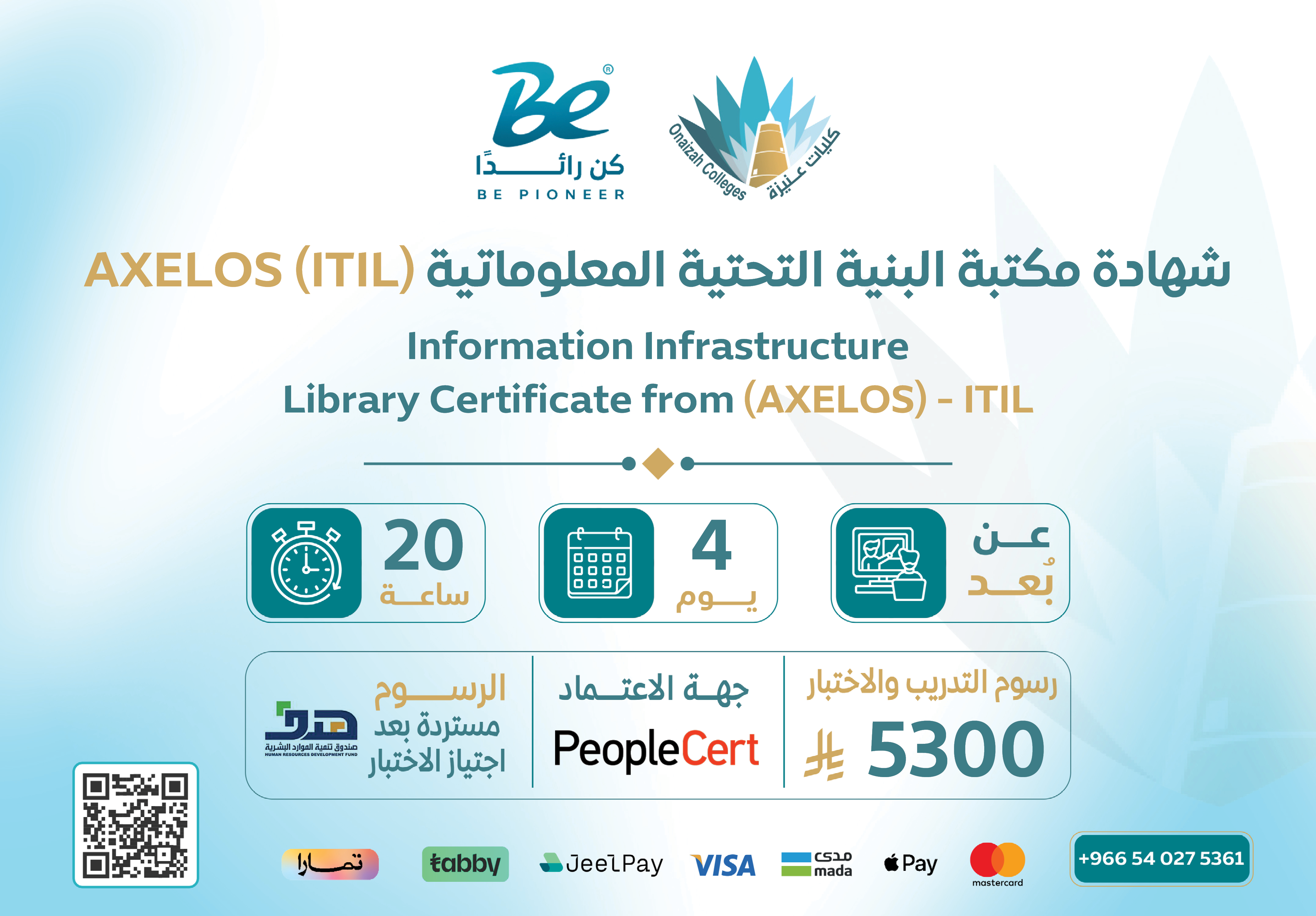
General Description
The ITIL (Information Technology Infrastructure Library) certification is a professional credential focused on IT service management and the practices used to deliver effective, value-driven technology services. ITIL has evolved into one of the widely recognized frameworks for understanding and managing IT service practices in modern organizations.
Studying ITIL helps professionals understand how IT services can be designed, managed, delivered, and continually improved in alignment with organizational and user needs. It provides knowledge of service management concepts and practices related to service quality, change, risk, operational improvement, and continual improvement.
Through Be Pioneer, professionals interested in IT service management can develop their understanding of modern service management practices and prepare for career opportunities related to IT Service Management. The certification can be relevant to IT professionals, service managers, technical support teams, project managers, and professionals involved in technology services and business operations.
As organizations increasingly depend on digital technologies and IT services to support their operations, effective IT service management has become an important part of business performance. The ITIL certification can help professionals understand the relationship between technology services and business requirements while supporting improved service quality, operational efficiency, and user experience.
With Be Pioneer, learners can build a stronger foundation in IT service management, enhance their professional understanding of ITIL practices, and prepare to contribute more effectively to organizations operating in increasingly digital and technology-driven environments.
The Goals
-
Introduce participants to the ITIL framework and enable them to understand how to design, operate, and improve IT services.
-
Enable participants to absorb the common language and key concepts used in modern digital service management environments.
-
Develop a practical understanding of how to align IT services with business needs and improve stakeholder experience.
-
Prepare participants to acquire a recognized professional foundation in IT Service Management.
-
Enhance participants' opportunities to work in technical support, service management, process improvement, and digital transformation fields.
-
Prepare participants to successfully pass the ITIL Foundation certification exam.
Target Auidence
-
Professionals working in information technology and IT service management.
-
Technical support and service desk employees.
-
Operations and quality improvement officers in organizations.
-
Those interested in IT service management and digital transformation.
-
Those seeking to build a professional foundation in IT Service Management.
-
Technical project and operations managers.
-
Anyone seeking to understand best practices in delivering IT services.
The Features
-
Globally recognized foundational certification as an entry point to the ITIL framework from PeopleCert.
-
Specialized training content in IT service management concepts and principles.
-
Development of professional understanding of the ITIL framework and its importance in service improvement and organizational performance efficiency.
-
Enhanced ability to align IT services with business needs and create value.
-
Suitable for beginners and professionals seeking to develop their career path in IT service management.
-
Flexible and organized learning experience through the Kun Ra'edan platform for training programs, part of Unaizah Colleges.
-
Foundation for transitioning to more advanced paths within the ITIL certification journey.
Topics
Main Domains (ITIL 4 Foundation):
-
Key Concepts of Service Management: Definition of service, value, product, customer, stakeholder, service provider-consumer relationship, value stream.
-
The Four Guiding Principles: Focus on value, start where you are, progress iteratively with feedback, collaborate and promote visibility, think and work holistically, keep it simple and practical, optimize and automate.
-
The Four Dimensions of Service Management: Organizations and people dimension, information and technology dimension, partners and suppliers dimension, value streams and processes dimension.
-
The Service Value Chain: Core activities: plan, improve, engage, design & transition, obtain/build, deliver & support.
-
ITIL Management Practices:
-
General management practices: Continuity management, information security management, relationship management, supplier management.
-
Service management practices: Incident management, problem management, request management, service level management, change management, release management, service desk.
-
Technical management practices: Deployment management, infrastructure and application management.
-
-
Continual Improvement: Continual improvement model, performance measurement, KPIs, improvement culture.
-
Digital Transformation and the Role of ITIL: How the ITIL framework supports digital transformation and enhances organizational performance efficiency.
Learning outcomes
-
Successfully pass the ITIL Foundation certification exam.
-
Comprehensive understanding of key concepts in IT service management according to the ITIL 4 framework.
-
Ability to use the common language of ITIL practitioners in work environments.
-
Ability to identify how to create and maintain value through digital products and service management.
-
Ability to apply the four guiding principles in improving processes and services.
-
Ability to align IT services with business needs and deliver value to stakeholders.
-
Qualification to transition to more advanced paths within the ITIL certification journey (ITIL Specialist, ITIL Strategist, ITIL Leader).
Requirements And Conditions
FAQs
The Blog
In a world where information technology has become the backbone of every organization, from small startups to massive government institutions, having a strong technical infrastructure is no longer enough on its own. What truly matters today is how that infrastructure is managed and how reliably its services are delivered to users and customers alike. This is exactly where the ITIL framework (Information Technology Infrastructure Library) comes in, standing as one of the most widely adopted frameworks in the world for IT service management. Certifications built on this framework, now managed by AXELOS, have become among the most sought-after professional credentials in the global technology job market.
This article traces the story of this long-standing framework and how it evolved over the years into a shared language spoken by IT professionals around the world. It also highlights the real career impact this certification can have, and the role of the Be Pioneer platform in guiding candidates through this path with professionalism and confidence.
What Is the ITIL Framework, and How Is It Connected to AXELOS?
ITIL is a comprehensive set of globally recognized best practices for managing IT services, originally developed by the British government back in the 1980s to standardize how technical services were delivered across government agencies. It later spread into the private sector and became a globally recognized standard across virtually every industry that relies fundamentally on information technology.
AXELOS is the global organization that currently owns the rights to develop, manage, and update the ITIL framework. It oversees the framework's body of knowledge, sets the standards for its exams, and accredits training and testing centers around the world. This means that any ITIL certification a person earns does not come from some random local training provider, but from a single global organization that guarantees the same level of quality and credibility no matter which country the candidate takes the exam in. This is precisely what gives the certification its real weight in the international job market.
At its core, the framework is built on the idea of viewing IT not as a collection of separate hardware and systems, but as integrated services that must be continuously designed, delivered, maintained, and improved to serve the actual needs of the business. This shift in perspective is what makes the framework so valuable to organizations seeking a genuine balance between technical efficiency and the actual business value that technology delivers.
Why Organizations and Employers Place So Much Trust in This Certification
When a large organization is looking to hire someone to manage its IT services, what it's really looking for is a person who understands how technology connects to broader business goals, not just someone skilled at handling hardware and software in isolation. This is exactly where the value of the ITIL certification lies. It doesn't just measure pure technical knowledge; it measures a person's ability to think within an integrated management framework that links technology, processes, and the value they add to the business.
This integrated way of thinking is precisely why employers around the world treat this certification as a core requirement or a clear advantage when hiring for roles such as IT service management, help desk management, technical project management, IT governance, and even higher-level consulting roles focused on designing comprehensive technology strategies for organizations. When a hiring manager sees this certification on a resume, they immediately understand that the candidate possesses a shared language and a clear methodology that can be put to work right away, without the need for lengthy training from scratch.
Many large corporations and multinational companies, particularly in banking, telecommunications, insurance, and e-government sectors, have adopted this framework as their internal standard for managing technical operations. This means certification holders find themselves well positioned to integrate quickly into work environments that already operate using the same methodology and terminology they learned while preparing for the certification.
The Certification's Structure and Progressive Levels
The ITIL certification path was designed to be cumulative, allowing candidates to start with the fundamentals of the framework and gradually build up to more specialized areas based on their role and career ambitions. The journey typically begins with the Foundation level, which gives candidates a comprehensive overview of the framework's core concepts, key terminology, and general approach to service management. This is the level recommended for anyone looking to build a solid base before moving into any deeper specialization.
After successfully passing the Foundation level, candidates can move on to more advanced levels, choosing specialized paths that dive deeper into specific aspects of the framework, whether that's the strategic side of service management, day-to-day operational aspects, or continuous improvement and performance measurement. As candidates progress along this cumulative path, they accumulate credits that eventually qualify them for the highest levels of accreditation in this field, reflecting a very high degree of mastery and the ability to apply the framework in complex, interconnected contexts within large organizations.
This flexible, tiered structure means the certification doesn't just serve beginners looking for general foundational knowledge; it also serves specialists who have already been working in the field for years and want to deepen their expertise in specific areas relevant to their daily work, whether that's incident and problem management, designing new services, or managing changes within an organization's technical environment.
How the Exam Works and How the Certification Is Earned
ITIL exams are typically structured as multiple-choice questions that assess a candidate's understanding of both the theoretical and practical concepts within the framework, with the nature and complexity of the questions varying depending on the level being tested. At the Foundation level, questions focus on measuring general understanding of core terminology and principles, while questions at higher levels shift toward more complex practical scenarios that require candidates to analyze a given situation and choose the most appropriate course of action based on the framework's principles, rather than simply recalling memorized facts.
These exams are usually administered through testing centers officially accredited by AXELOS, or through remote online proctoring systems that allow candidates to take the exam from anywhere in the world, provided they comply with strict conditions to ensure exam integrity. This reflects the flexibility the organization has built in to make this credential accessible to as many professionals as possible around the world, without requiring travel or being tied to a specific location.
Once a candidate passes the exam, they receive a digital certificate that can be verified electronically, which is typically added to their profile on professional platforms like LinkedIn. This gives them greater visibility to hiring managers and specialized recruitment agencies specifically searching for this type of credential when looking for candidates for technical management roles.
The Real-World Career Impact of This Certification
When someone earns an ITIL certification, they are effectively adding objective proof to their resume that they possess a professional way of thinking about IT service management. This proof becomes a real differentiator in a crowded job market full of candidates who have practical technical experience but lack a clear methodological framework to direct that experience toward creating actual value for an organization.
Professionals already working in the field also find this certification to be a powerful tool for strengthening their position when negotiating a promotion or a raise, since it gives them a shared language they can use to discuss with senior management how to improve technical operations in ways that serve the organization's strategic goals, rather than being limited to purely technical conversations that non-technical decision-makers may struggle to follow.
This certification also opens wide doors for those looking to move from purely hands-on technical roles into higher management or consulting positions, since it acts as a knowledge bridge connecting the purely technical side with the strategic management side, exactly the combination many organizations look for when selecting IT department leaders or digital transformation consultants.
How to Prepare Effectively for This Path
Passing ITIL certifications requires more than a casual read-through of the material. The framework contains a substantial body of interconnected concepts, terminology, and processes, which calls for a structured study plan that starts with understanding the big picture of the framework as a whole before diving into the finer details of each individual process. It's extremely helpful to rely on realistic, practical examples and scenarios while studying, rather than rote memorization of definitions, since exams at the more advanced levels measure the ability to apply knowledge far more than they measure simple recall.
It's also strongly recommended to practice with past exam samples or mock questions similar to what will appear on the actual exam, as this helps candidates get familiar with how questions are phrased and the kind of thinking required to answer them correctly, especially since some questions may include more than one answer that seems correct on the surface, when in fact only one aligns precisely with the framework's specific principles and methodology.
Because this path can feel overwhelming and complex for someone tackling it alone without guidance, joining a structured training program that offers clear, sequential explanations along with opportunities for hands-on practice and ongoing review makes a real difference in the preparation experience. It significantly reduces the time and effort needed to reach full exam readiness with confidence.
The Role of Be Pioneer in Supporting Your Journey
With this in mind, the Be Pioneer platform offers specialized training programs that guide trainees step by step through the process of preparing for ITIL certifications, from the Foundation level all the way up to the more advanced tiers. This is achieved through a training methodology that combines simplified explanations of theoretical concepts with hands-on application of realistic scenarios inspired by actual working environments in the IT sector.
The platform's training team makes a point of continuously updating its content to keep pace with any developments or changes AXELOS makes to the framework, which is critically important, since relying on outdated or unrevised sources could lead trainees toward information that no longer aligns with the latest version of the framework. The platform also provides an interactive environment where trainees can ask questions directly to instructors with genuine, hands-on experience applying this framework within different organizations, adding a real practical dimension that theoretical study materials alone simply cannot provide.
Thanks to this integrated approach, trainees on Be Pioneer find a clear, organized path that reduces the sense of confusion often felt by those attempting to prepare for such a broad body of knowledge on their own, while also giving them the confidence they need to sit for the official exam and pass it on their first attempt.
Anyone considering pursuing an ITIL certification from AXELOS should understand that this credential is not just a passing addition to a resume, but a genuine, long-term investment in their professional future, especially given the continuously expanding role of information technology across nearly every business sector. Those who hold this certification gain a shared language that allows them to communicate effectively with different stakeholders within their organization, from purely technical teams all the way up to senior management responsible for strategic decision-making.
More importantly, choosing a clear, structured training path from the very start saves a great deal of the time and effort that could otherwise be wasted on unguided, scattered preparation attempts. Joining a comprehensive training program, like the one offered by Be Pioneer, sets trainees on the right path from day one and gradually, with full confidence, brings them closer to the moment they pass the exam and earn a credential that opens up broad professional horizons in the ever-accelerating world of information technology.
In conclusion, the ITIL certification from AXELOS remains one of the most valuable credentials for anyone working in, or aspiring to work in, IT service management, because it combines global credibility, an integrated practical methodology, and a tangible impact on career progression and professional opportunities. Anyone who begins this journey with deliberate steps and serious training will, within a relatively short time, find themselves holding a globally recognized credential that opens doors they may have once thought were far out of reach.