General Description
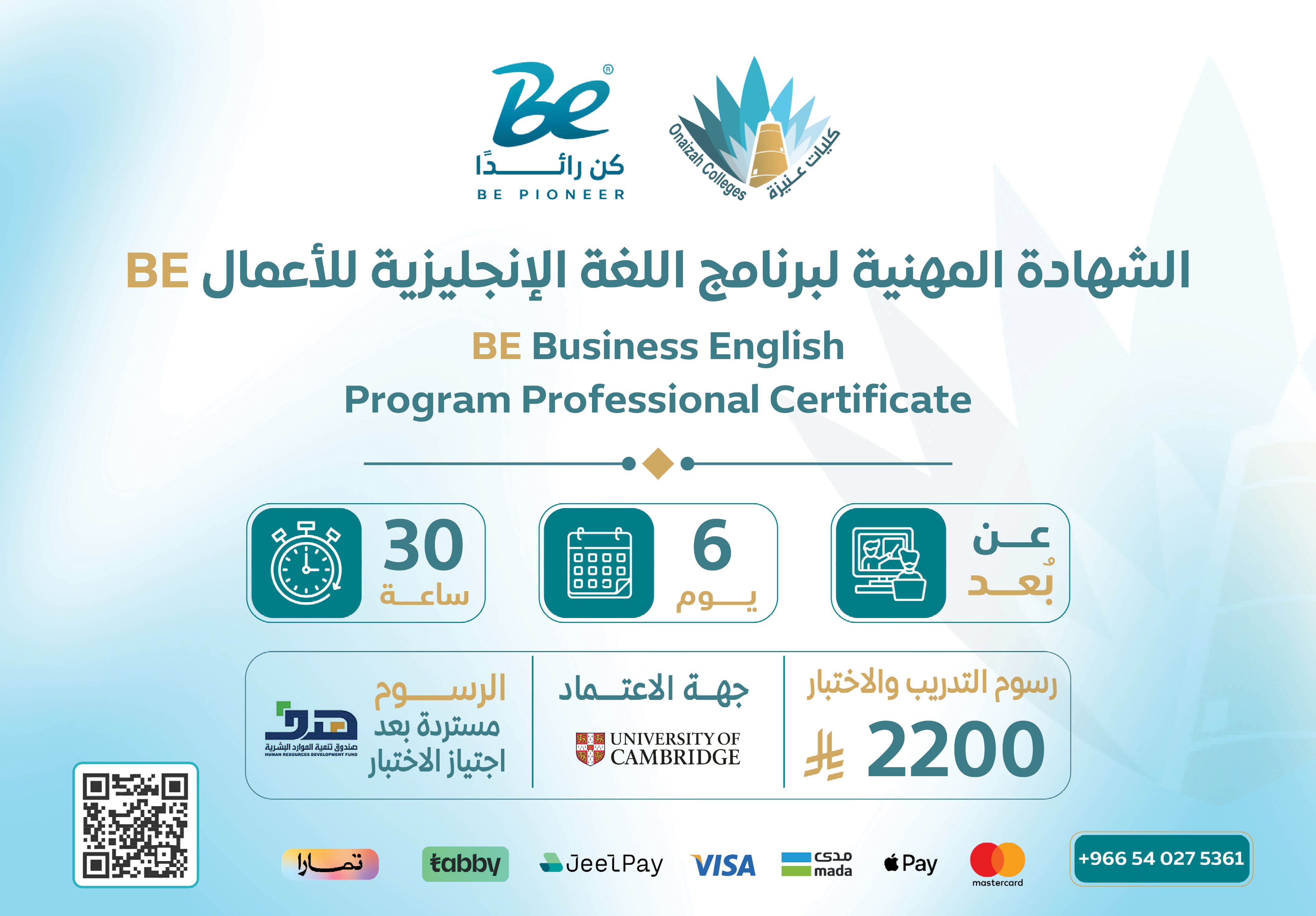
The Professional Business English (BE) Program Certification is designed to develop English language skills for professional and business environments. It helps learners improve their ability to communicate effectively in English in practical workplace situations, supporting interactions with colleagues, clients, partners, and international teams.
The Business English (BE) program focuses on language skills that professionals commonly need in their daily work, including professional communication, business correspondence, workplace vocabulary, meetings, discussions, and professional conversations. It can help learners communicate their ideas more clearly and confidently in English.
Through Be Pioneer, learners can benefit from a structured learning experience designed to strengthen their English communication skills within professional contexts. The certification can also contribute to a stronger professional profile, particularly for individuals working in roles that involve communication with English-speaking clients, organizations, or multinational teams.
English has become increasingly important in modern business environments as organizations expand internationally, adopt remote working models, and collaborate across different countries and cultures. Strong business English skills can help professionals communicate more effectively, understand professional content, and participate confidently in workplace interactions.
The Professional Business English (BE) Program Certification can be suitable for employees, job seekers, students, and professionals who want to improve their English skills for career development. With Be Pioneer, learners can take a practical step toward strengthening their professional communication abilities and preparing for career opportunities where effective English communication is essential.
The Goals
-
Develop applied English language skills used in various work environments and organizations.
-
Enable trainees to communicate effectively and professionally in English through both oral conversations and written correspondence.
-
Provide trainees with common business terminology and expressions to use with confidence.
-
Bridge the gap between general language knowledge and the language requirements of the job market.
-
Enhance employment and career advancement opportunities in local and international work environments.
-
Prepare participants to successfully pass the Business English (BE) Professional Certification exam.
Target Auidence
-
Students seeking to develop their language skills for professional purposes before graduation.
-
Employees across various sectors (government, private, non-profit) that require English language use.
-
Job seekers wanting to enhance their career opportunities and add value to their CVs.
-
Business owners and entrepreneurs who deal with international partners or clients.
-
Anyone seeking to use English confidently in the workplace, regardless of their current level.
-
Beginners in English learning who want to focus on the professional and applied side.
The Features
-
Certified professional certification focusing on applied Business English in work environments, not general academic English.
-
Bridging the gap between general language knowledge and actual job market requirements.
-
Practical applied content based on real professional situations (calls, meetings, emails, reports, negotiation).
-
Comprehensive development of all four language skills: reading, writing, listening, and speaking in a business context.
-
Suitable for all levels from beginners to advanced, with focus on professional usage.
Topics
Main Domains:
-
Introduction to Business English:
-
Concept of Business English and the difference between it and General English
-
Basic phrases and expressions used in daily work environments
-
Professional etiquette
-
-
Telephone & Meeting Skills:
-
Taking and receiving professional calls
-
Scheduling, confirming, and rescheduling appointments
-
Leaving professional voicemails
-
Participating in meetings: giving opinions, asking questions, politely objecting, summarizing points
-
-
Email & Professional Correspondence:
-
Email writing basics (subject, greeting, opening, body, closing, signature)
-
Writing formal and semi-formal emails
-
Responding to inquiries and follow-ups
-
Writing memos and formal letters
-
-
Reports & Presentations:
-
Writing short professional reports
-
Report structure: introduction, findings, recommendations
-
Preparing clear and engaging presentations
-
Language of explanation, clarification, and persuasion in the workplace
-
-
Negotiation & Professional Relationships:
-
Vocabulary and expressions used in negotiation (opening, proposing, bargaining, closing)
-
Successful negotiation strategies (Win-Win negotiation)
-
Building professional relationships with colleagues, clients, and partners
-
Handling cultural differences in multinational work environments
-
-
Business & Professional Terminology:
-
Key terms in Management
-
Marketing and Sales terminology
-
Human Resources terminology
-
Basic Finance and Accounting terminology
-
Using terminology in practical situations
-
-
Applied Conversation & Oral Presentation:
-
Role-plays of real workplace situations
-
Delivering oral presentations to a group
-
Participating in virtual meetings (Zoom, Teams, Meet)
-
Speaking fluently and confidently in front of others
-
Handling questions and objections during presentations
-
Learning outcomes
-
Successfully pass the Business English (BE) Professional Certification exam.
-
Ability to use English effectively and confidently in daily work situations.
-
Ability to conduct telephone conversations and participate in professional meetings in English.
-
Ability to write professional correspondence (emails, memos, formal letters) professionally.
-
Ability to write short reports and prepare clear presentations in English.
-
Ability to use appropriate business and professional terminology in various contexts.
-
Ability to communicate confidently in multicultural and multinational work environments.
-
Enhanced employment and career advancement opportunities in local and international markets.
Requirements And Conditions
1. Having basic knowledge of English grammar and vocabulary used in business environments.
2. Previous experience in business, management, or professional communication is preferred.
3. Understanding the basics of formal writing such as preparing reports, emails, and presentations.
4. Familiarity with terminology in business fields such as marketing, sales, human resources, and finance.
5. Ability to communicate effectively both orally and in writing in business meetings and negotiations, and commitment to studying to pass the certification exam.
FAQs
The Blog
As global markets open up and companies increasingly expand across borders, English has stopped being just a supplementary skill briefly mentioned on a resume. It has become an essential work tool that largely determines an employee's ability to communicate effectively, advance professionally, and even compete for opportunities in international environments. But general English proficiency, the kind learned in school or university, is fundamentally different from mastering the "language of business" actually used in meetings, formal correspondence, presentations, and business negotiations. This is exactly why the Professional Certification in Business English (BE) has emerged as a specialized credential that bridges this subtle but critical gap between general English and professional workplace language.
This article explores the scope and growing importance of this certification in today's global job market, how it impacts the career trajectory of those who hold it, and the role of the Be Pioneer platform in guiding candidates through preparation for this credential with professionalism and confidence.
What Exactly Is the Professional Certification in Business English?
This certification focuses on measuring and developing a person's ability to use English in actual workplace contexts, rather than simply assessing general language knowledge disconnected from any real professional application. While general English courses focus on teaching the basic grammar and vocabulary needed for everyday communication, the BE certification goes well beyond that, testing a person's ability to draft a formal email in an appropriately professional tone, participate effectively in a business meeting with participants from different nationalities, deliver a compelling presentation to senior management or international clients, or even negotiate the terms of a business contract with tact and diplomacy.
This type of certification relies on a comprehensive teaching methodology that combines the four core language skills, listening, reading, writing, and speaking, but directs each of these skills toward a direct workplace context rather than general social or academic settings. This specialized, practical orientation is exactly what sets this certification apart from many traditional English certifications, which measure general language proficiency without specifically focusing on the vocabulary, structures, and situations unique to a professional work environment.
Why This Certification Has Become an Increasing Requirement in the Modern Job Market
In a world where even local companies now regularly deal with international suppliers, clients, and partners, the ability to communicate in professional English has become a decisive factor in the success of many job roles, from a customer service representative dealing with foreign clients, to an executive negotiating cross-border deals. In this context, it's no longer enough for a job candidate to write a vague line on their resume like "proficient in English," a phrase that has become almost meaningless from overuse without any objective proof behind it.
This is exactly where the BE certification serves as objective, verifiable proof. Holders can present formal evidence that they don't just have general English proficiency, but also the ability to use it effectively in real, complex workplace contexts. This kind of proof has become highly sought after in roles like international marketing, sales, customer service for foreign markets, human resources at multinational companies, international project management, and even senior management roles that require representing a company in front of foreign partners or investors.
Many major corporations and international organizations, particularly in tourism, aviation, banking, and technology, have also started treating business English proficiency as a core requirement or a clear advantage when hiring or considering internal promotions. This means certification holders find themselves in a far stronger competitive position compared to those relying solely on unverified, general language ability.
The Practical Skills This Certification Focuses On
This certification covers a broad range of applied language skills that together form a complete system for effective professional communication. It typically begins with formal writing skills, where candidates learn how to draft professional emails in a style that is clear, direct, and polite at the same time, while understanding the subtle but important differences between formal and informal correspondence styles, differences that may seem minor but significantly affect the impression left on the recipient, especially in international work environments governed by precise communication norms.
The focus then shifts to speaking and listening skills in different workplace contexts, such as actively participating in meetings, asking questions in a professional manner, expressing an opinion or a disagreement tactfully without breaking the norms of professional respect, along with careful listening skills needed to catch fine details in complex discussions that may involve specialized technical or business terminology. This certification also places special emphasis on presentation skills, teaching candidates how to organize their ideas and deliver them confidently and persuasively to a diverse audience, whether that audience consists of internal colleagues or external clients and partners.
Because negotiation is considered one of the most sensitive skills in an international work environment, this certification also covers how to use English skillfully during business negotiations, from framing proposals persuasively, to handling objections and rejection diplomatically in a way that preserves the long-term professional relationship between different parties.
The Career Impact of This Certification
Many professionals working in international environments notice that earning a specialized certification like BE creates a genuine, meaningful shift in how they handle daily tasks that require English communication. Instead of feeling hesitant or anxious when needing to write an important formal message or participate in an international meeting, a person becomes far more confident and fluent in expressing their ideas clearly and professionally. This shift is directly reflected in the quality of their job performance and in the impression they leave on colleagues, managers, and clients.
Certification holders also find themselves in a stronger negotiating position when discussing promotion opportunities or moving into roles that require intensive international communication, since the certification provides objective, measurable proof of their professional language competency, rather than relying solely on personal impressions that may be inaccurate or not formally documented. In some cases, this certification opens doors to positions at international companies or remote work with teams distributed around the world, where business English proficiency is treated as an absolute, non-negotiable requirement.
The impact isn't limited to purely professional outcomes; it also extends to a person's personal confidence in handling a variety of social and professional situations outside of direct work, such as attending international conferences, engaging with a global professional network, or even following specialized professional content in English without needing extra mental effort to understand and translate it.
How to Prepare Effectively to Pass This Certification with Confidence
Good preparation for this certification requires more than simply reviewing general grammar rules. Many people who are quite fluent in English on a social level may find real difficulty transitioning into formal work contexts that demand greater precision in choosing the vocabulary and structures appropriate for each situation. It's therefore extremely helpful for candidates to start by familiarizing themselves with the common vocabulary and expressions used in different workplace settings, such as meeting vocabulary, formal correspondence vocabulary, and vocabulary for presentations and business negotiations.
It's also strongly recommended to consistently practice writing actual sample professional emails and to try simulating real meeting or presentation situations, since this kind of hands-on practice strengthens the ability to use the language confidently in real situations, rather than relying solely on theoretical knowledge that may not be sufficient on its own when facing a real workplace situation that requires a quick, appropriate response. It also helps to regularly listen to audio or video content covering real workplace situations in English, such as sample meeting recordings or professional presentations, since this strengthens listening and comprehension skills within a realistic professional context.
Because this kind of comprehensive preparation can be difficult to manage alone without clear guidance, particularly when it comes to precise feedback on weaknesses in tone, pronunciation, or writing, joining a structured training program that offers ongoing support and guided practice makes a real difference in the quality of preparation and how quickly candidates reach the professional fluency level required.
The Role of Be Pioneer in Supporting Your Professional Language Journey
The Be Pioneer platform offers specialized training programs carefully designed to guide trainees step by step through the process of preparing for the Business English professional certification. This is achieved through a teaching methodology that combines clear explanations of business English rules and conventions with intensive hands-on application to realistic situations inspired by different workplace environments, whether international meetings, formal correspondence, presentations, or business negotiations.
Instructors on the platform, who bring genuine hands-on experience using English in diverse international work environments, make it a priority to connect every language concept to a tangible, real-world situation, so that trainees don't leave a training session with theoretical knowledge disconnected from reality, but with an actual communication skill they can apply immediately in their daily work. The platform also provides detailed individual follow-up for each trainee, including ongoing assessment of their progress across different language skills and clear feedback on areas that need further practice and improvement.
What sets a trusted platform like Be Pioneer apart is its commitment to designing training content that reflects the actual needs of today's job market, rather than relying on generic educational materials that may not fit the nature of contemporary professional communication. The platform also provides a genuinely interactive environment where trainees can practice speaking and writing directly with specialized instructors, rather than being limited to static training materials that allow no real interaction to build fluency and language confidence.
Anyone seriously considering pursuing the Professional Certification in Business English should understand that this credential is not simply another line to add to a list of qualifications, but a genuine investment in developing an essential communication tool, one that has become one of the most in-demand skills in a globalized job market increasingly driven by collaboration and communication across geographic and cultural borders. Every hour spent in serious preparation and continuous hands-on practice eventually translates into greater confidence when handling complex international work situations, broader career opportunities, and stronger negotiating power when discussing professional and career growth.
More importantly, choosing a clear, structured training path from the very start saves a great deal of the time and effort that could otherwise be wasted on unguided, scattered preparation attempts. Joining a comprehensive training program, like the one offered by Be Pioneer, sets trainees on the right path from day one and gradually, with full confidence, brings them closer to the moment they pass the exam and earn a credential that meaningfully and sustainably strengthens their position in the global job market.
Ultimately, the Professional Certification in Business English (BE) remains one of the smartest investments any ambitious person can make in their career, because it combines mastery of an essential global communication tool, the practical ability to use it confidently in the most delicate professional situations, and a tangible impact on career advancement opportunities and openness to the international job market. Anyone who begins this journey with deliberate steps and serious training will, within a relatively short time, find themselves holding a credential that opens up broad professional horizons in a work world whose boundaries stop at no single language or culture.