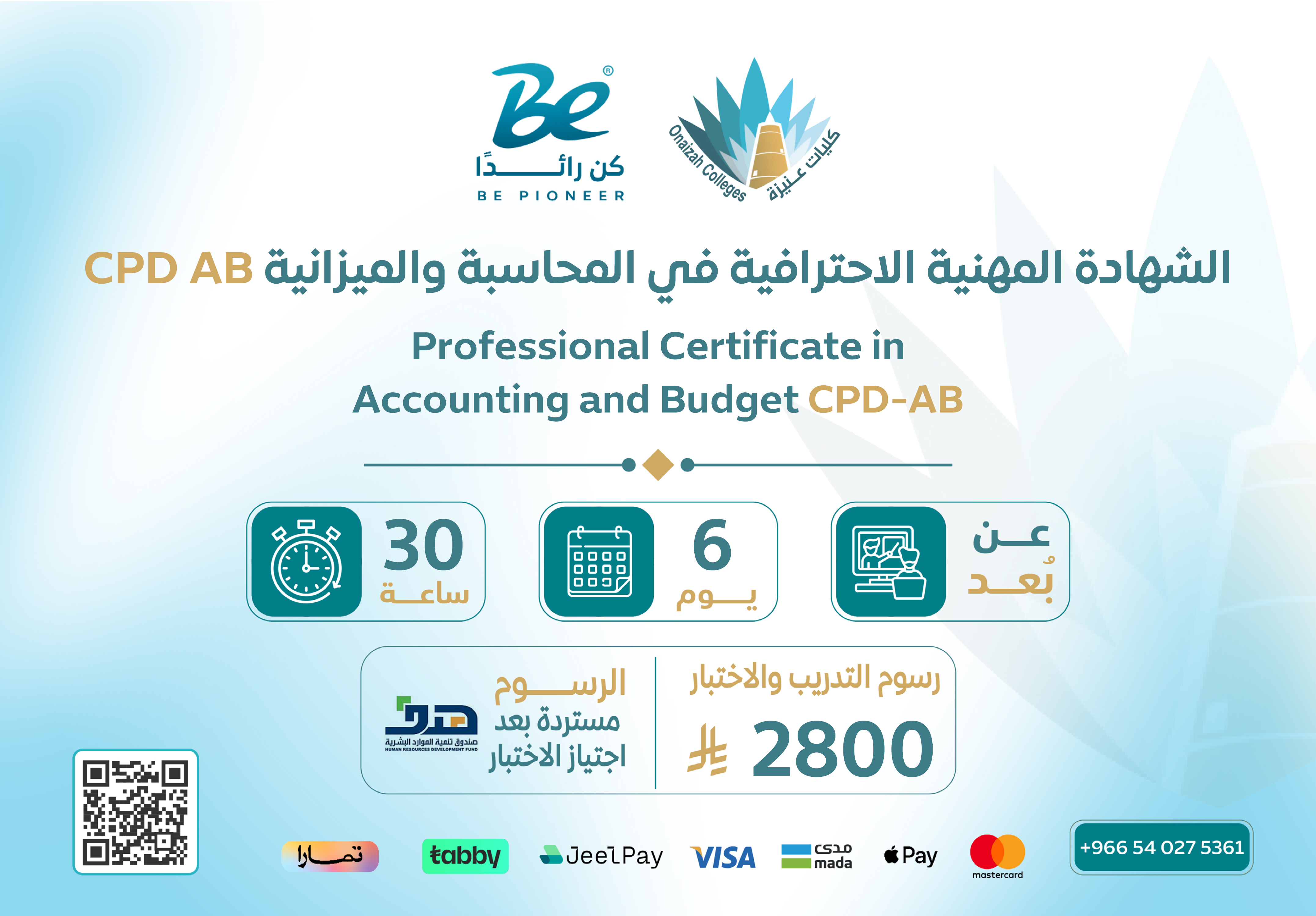
General Description
The Professional Certification in Accounting and Budgeting (CPD-AB) is a professional credential designed to support the development of professionals working in accounting, budgeting, and financial management. It helps learners strengthen their understanding of accounting and financial concepts related to budgeting, financial performance, resource management, and business decision-making.
The importance of specialized knowledge in accounting and budgeting continues to grow as organizations rely on accurate financial information to plan resources, monitor expenses, evaluate performance, and make informed decisions. The CPD-AB certification provides professionals with an opportunity to develop a broader understanding of the relationship between accounting, budgeting, and financial performance.
Through Be Pioneer, learners can strengthen their professional knowledge in accounting and budgeting and build a stronger understanding of financial practices used across different business environments. The certification can also add value to the professional profile of individuals seeking to enhance their existing expertise or advance their careers in accounting and finance.
The certification can be relevant to accounting professionals, finance employees, budgeting specialists, and professionals whose roles involve financial reporting, planning, expense monitoring, or revenue management. It can also be suitable for individuals who want to establish a stronger professional foundation in accounting and budgeting.
With Be Pioneer, learners can take a practical step toward developing their professional capabilities, improving their understanding of accounting and financial concepts, and preparing for responsibilities related to accounting and budgeting in today’s business environment.
The Goals
-
Provide participants with theoretical and practical expertise to understand the language of numbers upon which major financial decisions are built.
-
Enable participants to confidently use financial and accounting terminology in daily work contexts.
-
Develop skills in accurately organizing accounts payable and receivable, and tracking financial flows.
-
Enable participants to transform numbers into clear, organized financial reports that support correct decision-making.
-
Clarify the fundamental difference between managerial accounting (serving management and decision-making) and traditional financial accounting.
-
Prepare participants to successfully pass the CPD-AB certification exam.
Target Auidence
-
Accountants and bookkeepers: Seeking to transition from data entry to data analysis and participation in financial decision-making.
-
Finance sector specialists: To deepen their understanding of budgets and financial statements for accurate project and investment opportunity evaluation.
-
Business owners and entrepreneurs: Wanting to understand the language of numbers within their companies to monitor financial performance and ensure sustainable growth.
-
Non-financial managers: Department heads who manage budgets and need to understand how their decisions impact financial results.
-
Recent graduates of business and economics colleges: Seeking to bridge the gap between academic study and actual job market requirements.
-
Government and non-profit sector employees: Working in financial departments seeking to apply best professional standards.
The Features
-
Practical and applied content through real-world cases and direct examples from the work environment.
-
Preparation for financial leadership positions for both beginners and those seeking promotion.
-
Training by certified instructors with deep financial and professional experience.
-
Assessment tests, analytical exercises, and budget simulation models ensuring mastery of every skill.
-
Live online training with direct interaction and access to recorded lectures.
-
Strong pathway to major international certifications such as CMA, CPA, and ACCA.
Topics
Module 1: Accounting Fundamentals and the Accounting Cycle
-
The role of accounting in business success
-
Basic accounting principles (matching, accrual, conservatism)
-
Journal entries, general ledger, and trial balance
-
The complete accounting cycle
Module 2: Financial Statements and Analysis
-
Preparing income statement, balance sheet, and cash flow statement
-
Financial statement analysis for informed decision-making
-
Reading numbers and understanding the story they tell
Module 3: Cost Analysis and Break-Even Point
-
Difference between fixed, variable, and semi-variable costs
-
Calculating the break-even point
-
Accurate cost center allocation
-
Pricing and product mix decisions
Module 4: Budget Preparation and Financial Control
-
Difference between budget and budgetary planning
-
Preparing operating and capital budgets
-
Financial performance monitoring and variance analysis
Module 5: Financial Ratios and Financial Forecasting using Excel
-
Measuring liquidity, profitability, efficiency, and solvency using financial ratios
-
Trend analysis and financial scenario forecasting
-
Using smart Excel tools in financial analysis
Module 6: Internal Control and Financial Governance
-
Protecting company assets through internal control systems
-
Difference between internal audit and external audit
-
Governance principles, segregation of duties, and fraud prevention
-
Ensuring transparency and integrity in financial reports
Learning outcomes
-
Successfully pass the CPD-AB certification exam.
-
Confidently speak the language of money and financial terminology in daily work.
-
Accurately organize accounts payable and receivable and understand company financial flows.
-
Prepare clear, organized financial reports that support correct decision-making.
-
Clearly distinguish between managerial accounting and financial accounting.
-
Analyze financial statements using financial ratios and Excel tools.
-
Prepare operating and capital budgets and monitor financial performance.
-
Apply internal control and governance principles to protect company assets.
Requirements And Conditions
1. Having basic knowledge of fundamental accounting concepts such as revenues, expenses, assets, and liabilities.
2. Previous experience in dealing with budgets or financial reports is preferred.
3. Understanding the basics of preparing and analyzing financial statements (income statement, balance sheet, cash flow statement).
4. Familiarity with the principles of financial planning and preparing operating and capital budgets.
5. Ability to use basic accounting tools (such as Excel) and commitment to studying to pass the certification exam.
FAQs
The Blog
The accounting and financial management field has seen rapid transformation in recent years, driven by the growing complexity of organizational financial systems and rising expectations for finance professionals to act as genuine partners in decision-making, not just executors of routine calculations. Amid this shift, the need has grown for specialized professional credentials that prove a person doesn't just know basic accounting rules, but has a deep understanding of how to manage budgets, analyze financial performance, and make decisions grounded in accurate data. This is exactly why the Certified Professional in Accounting and Budgeting (CPD-AB) has earned its place as one of the most sought-after credentials among finance professionals serious about advancing their careers in a tangible way.
This article explores the scope and growing importance of this certification in today's job market, how it impacts the career trajectory of those who hold it, and the role of the Be Pioneer platform in guiding candidates through preparation for this credential with professionalism and confidence.
What Exactly Is the Certified Professional in Accounting and Budgeting Credential?
CPD-AB is a specialized professional certification that combines traditional accounting knowledge with the practical skills involved in preparing, managing, and monitoring budgets, a combination rarely offered together in traditional academic programs, which often treat these two areas as if they were entirely separate disciplines. In practice, accounting and budgeting cannot be separated: accounting provides the accurate data on actual financial performance, while budgeting relies on that data to build realistic, achievable future projections. Any gap in understanding how the two connect directly undermines the quality of financial decisions within any organization.
Holders of this credential focus on mastering a set of practical competencies, including reading and deeply analyzing financial statements, understanding the mechanics of preparing operating and capital budgets, tracking variances between planned and actual figures, and delivering recommendations based on this analysis to support organizational decision-making. This practical orientation is what sets this certification apart from many purely theoretical credentials that only test memorization without confirming a candidate's ability to actually apply that knowledge in a real work environment.
Why This Certification Has Become an Increasing Requirement in the Financial Job Market
In any organization, whether a commercial company, a government agency, or a nonprofit, the budget serves as the backbone that determines how limited financial resources are allocated across competing priorities, and how well the organization can achieve its strategic goals within clear financial limits. Because this process is so sensitive and consequential, employers increasingly look for finance professionals who can formally prove they're capable of handling this responsibility competently, and this is exactly where specialized certifications serve as objective, verifiable proof of that competency.
When a job candidate lists CPD-AB on their resume, they're sending a clear signal to the employer: this is not someone limited to recording daily accounting entries, but someone capable of seeing the bigger financial picture of the organization and understanding how accounting figures connect to strategic plans and operating budgets. This kind of dual competency has become highly sought after in roles like financial analyst, budget officer, management accountant, and finance manager at small and medium-sized organizations, and even in higher-level financial consulting roles that require an integrated understanding of financial planning and control processes.
Many organizations operating under strict financial oversight, such as government bodies, international organizations, and publicly listed companies, have also shown a clear preference for hiring staff who hold specialized budgeting credentials, since doing so reduces the risk of serious financial errors that can result from insufficient experience or an inadequate understanding of sound financial planning practices.
The Scope of Knowledge Covered by This Certification
This certification covers a broad range of interconnected topics that together form a complete framework for understanding financial operations within organizations. The path typically begins by reinforcing a deep understanding of core accounting principles and how they're applied in preparing key financial statements, such as the income statement, balance sheet, and cash flow statement, with an emphasis on reading these statements with a critical, analytical eye rather than simply preparing them mechanically.
From there, the content moves into the more specialized territory of budgeting, where candidates learn different approaches to preparing budgets, whether traditional budgeting that uses prior years' figures as a planning baseline, or zero-based budgeting, which requires justifying every single line item from scratch regardless of historical figures. The content also covers how to track budget execution throughout the financial period, analyze variances between planned and actual figures, and understand the root causes behind those variances, whether internal or tied to external market factors.
Because modern financial work cannot be separated from strategic decision-making, this certification places special emphasis on turning financial analysis into practical, actionable recommendations, so that a finance professional's role isn't limited to presenting numbers, but extends to actively contributing to shaping the decisions that determine an organization's financial future in the short, medium, and long term.
The Career Impact of Earning This Certification
Many professionals working in finance notice that earning a specialized certification like CPD-AB creates a real shift in how colleagues and managers perceive their capabilities. Instead of being seen as someone who simply executes routine accounting tasks, they start being treated as a financial advisor capable of delivering deep analytical insights that contribute to improving the organization's overall financial performance. This shift in perception is often accompanied by real opportunities for promotion into supervisory or higher management roles, particularly within finance departments looking for leaders who can combine accounting precision with strategic vision.
Certification holders also find themselves in a stronger negotiating position when discussing salaries or incentives, since a professional credential provides objective, measurable proof of their competency level, rather than relying solely on years of general experience, which don't necessarily reflect the depth of knowledge or the quality of actual performance. In some cases, this credential opens doors to entirely new sectors, such as moving from a small commercial company into an international organization or a nonprofit that requires advanced budget management skills aligned with global standards.
The impact isn't limited to purely professional outcomes; it also extends to the finance professional's personal confidence in handling complex financial challenges that might arise at any time within the organization, whether that's a sudden cash flow crisis, the need to restructure a budget due to market shifts, or the need to present a compelling financial justification for a new investment project to the board of directors.
How to Prepare Seriously to Successfully Pass This Certification
Effective preparation for this certification requires building a balanced study plan that combines reviewing theoretical accounting concepts with applying them practically to realistic cases and models drawn from actual work environments. It's extremely helpful for candidates to start with a comprehensive review of fundamental accounting principles to ensure there are no knowledge gaps that could affect their understanding of the more advanced topics related to budgeting and financial analysis.
It's also advisable to practice building complete budgets from scratch and to work through hypothetical exercises analyzing variances between planned and actual figures, since this kind of hands-on practice strengthens the analytical thinking required in the actual exam and reduces reliance on theoretical memorization alone, which isn't sufficient on its own to pass an exam that primarily tests practical application.
Another important aspect of good preparation is getting comfortable with interpreting financial results within the broader context of an organization's performance and strategic goals, rather than treating numbers in isolation from the context that produced them. A candidate who develops the habit of asking, "What does this number actually mean for the organization's decisions?" instead of simply calculating the number itself, is in a much stronger position when facing complex analytical questions during the exam.
Because this kind of comprehensive preparation can be difficult to manage alone without clear guidance, joining a structured training program that offers ongoing support and precise feedback makes a real difference in the quality of preparation and the level of confidence candidates bring to the official exam.
The Role of Be Pioneer in Supporting Your Journey Toward This Credential
The Be Pioneer platform offers specialized training programs carefully designed to guide trainees step by step through the process of preparing for the CPD-AB certification. This is achieved through a teaching methodology that combines clear explanations of accounting and financial concepts with intensive, hands-on application to realistic case studies drawn from a variety of work environments, whether commercial companies, government institutions, or nonprofit organizations.
Instructors on the platform, who bring genuine practical experience in both accounting and budgeting, make it a priority to connect every theoretical concept to a tangible practical application, so that trainees don't leave a training session with isolated theoretical knowledge, but with a deep understanding of how to apply that knowledge in their actual day-to-day work. The platform also provides detailed individual follow-up for each trainee, including ongoing assessment of their progress, identifying strengths to build on, and pinpointing the areas that need further focus and review before sitting for the official exam.
What sets a trusted platform like Be Pioneer apart is its commitment to continuously updating its training content to keep pace with the latest practices and standards in accounting and budgeting, which is critically important in a field that keeps evolving alongside changing financial regulations and systems. The platform also provides a genuinely interactive environment where trainees can ask questions directly and discuss complex practical cases with specialized instructors, rather than being limited to static training materials that allow no real interaction.
A Final Word Before Starting This Journey
Anyone seriously considering pursuing the CPD-AB certification should understand that this credential is not simply another line to add to a list of qualifications, but a genuine investment in developing strategic financial thinking, a skill that has become one of the most in-demand capabilities in today's constantly shifting financial job market. Every hour spent in serious preparation and ongoing hands-on practice eventually translates into greater confidence when facing real financial challenges, broader career opportunities, and stronger negotiating power when discussing personal professional and financial growth.
More importantly, choosing a clear, structured training path from the very beginning saves a great deal of the time and effort that could otherwise be wasted on unguided, scattered preparation attempts. Joining a comprehensive training program, like the one offered by Be Pioneer, sets trainees on the right path from day one and gradually, with full confidence, brings them closer to the moment they pass the exam and earn a professional credential that meaningfully and sustainably strengthens their position in the financial job market.
Ultimately, the Certified Professional in Accounting and Budgeting (CPD-AB) remains one of the smartest investments any finance professional can make in their career, because it combines deep accounting knowledge, practical budget management skills, and a tangible impact on career advancement opportunities and professional confidence. Anyone who begins this journey with deliberate steps and serious training will, within a relatively short time, find themselves holding a credential that opens up broad professional horizons in the ever-evolving world of finance and accounting.