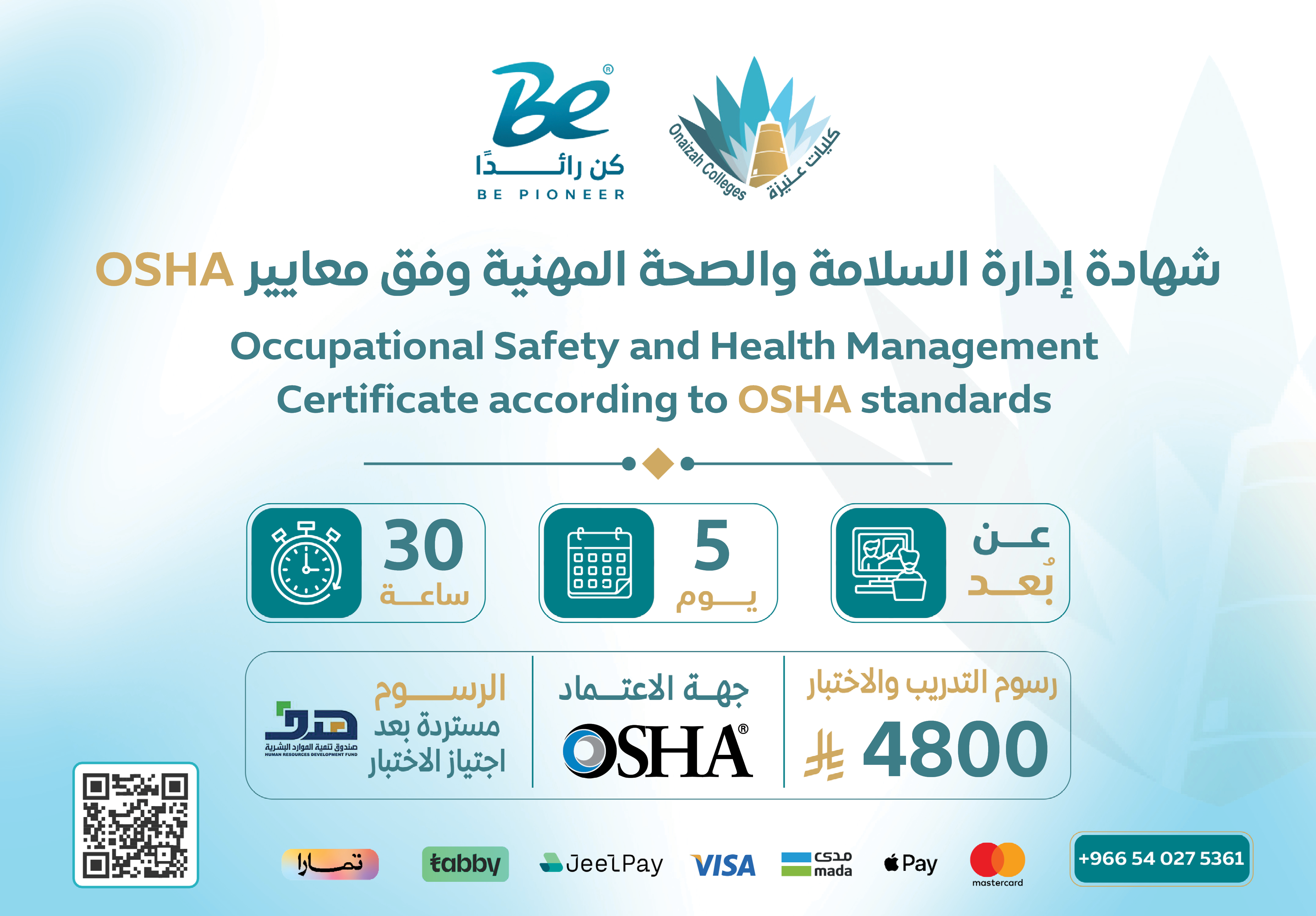
General Description
In any workplace, "human life" remains the most precious thing we have. If you are looking for the global gold standard for protecting lives and property, there is nothing stronger than OSHA standards. We are here to bring you this global expertise in a practical way that enables you to transform any hazardous work environment into a safe and organized place.
Through the Occupational Safety and Health Management Certification according to OSHA standards, offered by the "BE PIONEER" platform for training programs, we will take you on a journey to understand international safety policies and regulations — not just to avoid accidents, but to become the leader who sets the standards of quality and safety in your organization.
The Goals
-
Provide participants with a practical understanding of OSHA global standards and how to transform safety from a "heavy duty" into a conscious daily practice.
-
Enable participants to detect and analyze hazards in different work environments and anticipate them before they occur.
-
Prepare participants to use checklists and conduct regular inspections to ensure a safe work environment.
-
Provide participants with safety procedures for working in confined spaces and at heights, and safe handling of equipment and hazardous materials.
-
Enable participants to develop and implement emergency preparedness plans and lead evacuation teams.
-
Prepare participants to pass the international OSHA exam to become globally certified practitioners.
Target Auidence
-
Anyone seeking to learn and apply global safety standards (OSHA).
-
Safety engineers and supervisors in all sectors (factories, oil facilities, production units).
-
Facility managers in commercial, residential, and educational buildings (schools and universities).
-
Engineers and technicians responsible for installations and construction site management.
-
Those seeking advanced training to enhance their professional career path in occupational safety and health.
-
HR and training officers responsible for safety culture in organizations.
The Features
-
Certification accredited according to OSHA global standards (US Occupational Safety and Health Administration).
-
Trainers from the field with practical experience in factories and companies.
-
Interactive training environment based on brainstorming, open discussions, group workshops, and practical case study analysis.
-
Flexibility to suit employee schedules through remote training while maintaining the highest educational quality.
-
Comprehensive coverage of seven training units covering all safety aspects from planning to field execution.
-
Direct preparation to pass the international OSHA exam and obtain global accreditation.
Topics
Module 1: Fundamentals of Occupational Safety and Health (OSHA)
-
Concept and importance of occupational safety and health
-
Legislative and legal frameworks
-
Roles and responsibilities of employers and employees according to OSHA standards
Module 2: Hazard Identification and Risk Assessment
-
Hazard classification (physical, chemical, biological, ergonomic, psychological)
-
Using the Risk Assessment Matrix
-
Job Hazard Analysis (JHA) system
-
Anticipating accidents before they occur
Module 3: Safety Management Systems (ISO 45001)
-
ISO 45001 requirements for occupational health and safety management
-
Establishing safety policies and objectives
-
Key Performance Indicators (KPIs) for safety
Module 4: Safety Procedures in Hazardous Environments (Detailed)
-
Electrical safety: Lockout/Tagout (LOTO) system
-
Difficult environments: Confined space work, working at heights, scaffolding
-
Machinery and equipment: Crane safety, forklifts, excavation and welding work
-
Hazardous materials: Handling compressed gases, flammable liquids, chemicals, and radiation
Module 5: Fire Prevention and Personal Protective Equipment (PPE)
-
Personal Protective Equipment (PPE): types, use, maintenance
-
Fire detection and alarm systems
-
Types of fire extinguishers and their uses
-
Fire extinguisher placement and evacuation routes
Module 6: Emergency Preparedness and Incident Investigation
-
Developing Emergency Response Plans
-
Forming evacuation and first aid teams
-
Incident investigation
-
Root Cause Analysis to prevent recurrence
Module 7: Building a Safety Culture and Training
-
Transforming safety into a lifestyle within the organization
-
Designing effective safety training programs
-
Raising employee commitment levels
-
Building a conscious, preventive, and sustainable safety culture
Learning outcomes
-
Pass the international OSHA exam and obtain accredited certification.
-
Master OSHA global standards and occupational safety and health requirements.
-
Ability to detect, analyze, and anticipate hazards before they occur using systematic tools.
-
Ability to prepare checklists and conduct regular safety inspections.
-
Master safety procedures for working at heights, in confined spaces, and handling hazardous materials.
-
Ability to develop and implement emergency plans and lead evacuation teams.
-
Ability to investigate incidents and conduct root cause analysis to prevent recurrence.
-
Ability to build a safety culture and design effective training programs.
Requirements And Conditions
1. Having basic knowledge of general safety principles or practical experience in an industrial or construction work environment.
2. Understanding the basics of risk assessment and identifying sources of hazards in the workplace.
3. Familiarity with the rights and responsibilities of workers and employers according to OSHA standards.
4. Ability to develop emergency response, evacuation, and first aid plans.
5. Commitment to studying and preparing to pass the certification exam accredited according to international OSHA standards.
FAQs
The Blog
OSHA Certification | Your First Step into the Occupational Safety and Health Field
Occupational safety and health has become an essential part of modern workplaces. Organizations across different industries need professionals who understand workplace hazards, know how to identify potential risks, and can contribute to creating safer working environments. Among the well-known training programs in this field is OSHA, which provides valuable foundational knowledge of workplace safety and health practices.
For professionals who are interested in building a career in occupational safety, OSHA training can be an important starting point. It can also benefit employees who work in environments where safety awareness and risk prevention are essential.
Through Be Pioneer, learners can explore professional training opportunities that help them develop their knowledge and strengthen their career paths in fields that are increasingly important to the modern labor market.
What Is OSHA Certification and Why Is It Considered an Essential Step?
When people search for OSHA certification, it is important to understand what the term actually refers to. In many cases, it refers to completion cards obtained through the OSHA Outreach Training Program, rather than a professional license or certification issued by OSHA.
The Occupational Safety and Health Administration, known as OSHA, provides Outreach Training Programs designed to increase workers' awareness of workplace hazards and teach them how to recognize, avoid, and prevent potential risks.
OSHA Outreach courses commonly include 10-hour and 30-hour training programs covering areas such as construction, general industry, maritime operations, and disaster site work.
The OSHA 10-hour program is generally designed to provide basic awareness of workplace hazards, while the OSHA 30-hour program offers more comprehensive training and is particularly suitable for supervisors and workers with greater safety-related responsibilities.
It is also important to clarify that an OSHA Outreach training card is not a professional certification or occupational license. OSHA itself explains that Outreach training is voluntary and does not replace training requirements that may apply to specific jobs, hazards, or workplaces.
Why Do Employers Value OSHA Training?
Workplace safety is directly connected to employee protection, business continuity, and the reduction of workplace accidents. For this reason, safety awareness has become an important skill across many industries, particularly construction, manufacturing, energy, logistics, facilities management, and industrial operations.
OSHA training helps learners develop a more structured approach to identifying and understanding workplace hazards. Instead of reacting to an accident after it occurs, safety professionals and employees can learn how to recognize risks in advance and take preventive measures.
Training may cover areas such as:
-
Identifying common workplace hazards.
-
Understanding basic safety procedures.
-
Recognizing employees' safety rights.
-
Understanding employer responsibilities.
-
Learning how to report workplace hazards.
-
Understanding the importance of personal protective equipment.
-
Developing greater awareness of emergency procedures.
According to OSHA, millions of workers have completed Outreach Training Programs, demonstrating the widespread use of this type of safety awareness training.
How Does OSHA Help Build Occupational Safety Knowledge?
Occupational safety is not simply about memorizing safety rules. It requires the ability to recognize hazards and understand how workplace conditions can affect employees.
A workplace may contain different types of risks, including electrical hazards, machinery-related hazards, chemical exposure, falls from heights, moving equipment, excessive noise, fires, and other operational risks.
OSHA training introduces learners to concepts that can help them understand these risks and the preventive practices associated with them.
The training also provides information about workplace safety rights, employer responsibilities, and hazard reporting. This makes OSHA training part of a broader safety culture rather than simply a collection of technical rules.
What Is the Difference Between OSHA 10 and OSHA 30?
One of the most common questions among people interested in OSHA training is the difference between the OSHA 10-hour and OSHA 30-hour programs.
OSHA 10-Hour Training
OSHA 10 is designed to provide workers with basic awareness of common workplace hazards and safety practices.
It can be a suitable starting point for individuals who are new to occupational safety or employees who need a general understanding of workplace risks.
The program focuses primarily on hazard awareness and basic prevention principles rather than providing advanced safety management training.
OSHA 30-Hour Training
OSHA 30 provides a broader and more detailed learning experience. It covers a wider range of safety topics and provides more extensive information than the 10-hour program.
The OSHA 30-hour program is generally more appropriate for supervisors, managers, and workers who have safety-related responsibilities.
However, choosing between OSHA 10 and OSHA 30 should depend on the learner's job responsibilities, industry, and employer requirements rather than simply choosing the longer course.
What Topics Can OSHA Training Cover?
The topics included in OSHA training vary depending on the specific program and industry.
Common areas may include:
Fall Protection
Falls are among the significant hazards in many workplaces, particularly construction environments. Training can introduce learners to basic fall hazards and prevention practices.
Electrical Safety
Electrical hazards can lead to serious workplace injuries. OSHA-related training can help workers understand common electrical risks and the importance of following appropriate safety procedures.
Personal Protective Equipment
Personal protective equipment, or PPE, plays an important role in protecting workers from workplace hazards. Training can explain when and why different types of protective equipment are used.
Hazardous Materials
Certain workplaces involve chemicals or other hazardous substances. Safety training can help employees understand potential exposure risks and the importance of appropriate handling and protective procedures.
Machinery and Equipment Safety
Workers in industrial and manufacturing environments may encounter machinery-related hazards. Understanding safe operating practices and hazard awareness is an important part of maintaining a safer workplace.
Emergency Preparedness
Safety training may also address emergency situations and the importance of understanding workplace emergency procedures.
The exact topics depend on the type of OSHA Outreach course and the industry for which it is designed.
The Importance of Occupational Safety and Health in the Job Market
The importance of occupational safety increases as workplaces become more complex and employees interact with machinery, equipment, construction sites, chemicals, and industrial processes.
A strong workplace safety culture can help organizations make prevention part of their daily operations. Safety is not limited to protecting employees; it can also contribute to protecting equipment, facilities, productivity, and business operations.
For professionals, knowledge of occupational safety can also strengthen their professional profile, particularly when applying for positions where workplace safety awareness is part of the job requirements.
This makes OSHA training a potentially valuable starting point for individuals who want to understand the fundamentals of occupational safety and health.
OSHA Certification in Saudi Arabia
Many professionals searching for OSHA certification in Saudi Arabia are interested in understanding how this training can support their professional development.
It is important to distinguish between an OSHA Outreach training card and a Saudi professional license or regulatory certification.
An OSHA Outreach card is not a Saudi professional license, and OSHA itself states that Outreach Training does not replace specific training requirements that may be imposed by employers, projects, or regulatory authorities.
Therefore, professionals planning to use OSHA training when applying for jobs in Saudi Arabia should review the specific requirements of the employer or position.
Nevertheless, OSHA training can provide useful knowledge of occupational safety principles and may complement other professional qualifications in the safety field.
What Is the Difference Between OSHA and NIOSH?
The terms OSHA and NIOSH are sometimes confused because both are associated with occupational safety and health in the United States.
OSHA stands for the Occupational Safety and Health Administration. It is part of the U.S. Department of Labor and focuses on workplace safety and health.
NIOSH, on the other hand, stands for the National Institute for Occupational Safety and Health. It is part of the Centers for Disease Control and Prevention and focuses heavily on research, scientific knowledge, and recommendations related to occupational safety and health.
In simple terms, both organizations contribute to workplace safety, but their roles are different.
Understanding this distinction can help learners avoid confusion when researching occupational safety programs and professional resources.
How to Verify an OSHA Certificate | OSHA Certification
When completing an OSHA-related training program, verifying the training provider is an important step.
OSHA explains that completion cards for Outreach Training Programs are issued through authorized Outreach trainers who meet the requirements of the program.
OSHA also provides information about authorized online Outreach Training Providers, making it possible for learners to check whether a provider is recognized within the program.
Before enrolling in an OSHA course, learners should therefore verify:
-
The type of OSHA program being offered.
-
The number of training hours.
-
The industry covered by the course.
-
The status of the training provider.
-
The type of completion card provided.
-
Whether the training meets the requirements of the intended employer or workplace.
Taking these steps can help learners avoid misleading or fraudulent training offers.
OSHA Certification Cost
There is no single worldwide price for OSHA training. The cost can vary depending on several factors, including:
-
The type of OSHA program.
-
The number of training hours.
-
The training provider.
-
Online or classroom delivery.
-
The industry covered.
-
Additional services included with the training.
For those searching for the OSHA certification cost in Saudi Arabia, it is therefore better to compare specific training programs rather than relying on a fixed price.
OSHA itself notes that independent trainers may establish different schedules and fees. As a result, learners should compare providers carefully and consider the quality and legitimacy of the training in addition to the price.
The cheapest course is not necessarily the best option if it does not meet the learner's professional requirements.
OSHA Certificate Sample
After successfully completing an OSHA Outreach Training Program, eligible participants receive a course completion card corresponding to the program they completed, such as a 10-hour or 30-hour card.
OSHA explains that Outreach Training Program student cards for construction, general industry, maritime, and disaster site workers do not have an expiration date printed on them.
However, this does not necessarily mean that an employer or project will accept an old training card indefinitely. Employers may establish their own requirements or request updated safety training based on workplace conditions.
Learners should therefore distinguish between the absence of an expiration date on the card and the requirements established by a particular employer.
How to Choose the Right OSHA Course
Choosing the right OSHA training starts with understanding your professional goals.
If you are interested in construction safety, you should look for a program designed specifically for the construction industry. If you work in manufacturing or another industrial environment, a general industry program may be more appropriate.
You should also determine whether OSHA 10 or OSHA 30 better matches your responsibilities.
Consider the following before enrolling:
-
Your industry: Choose training that reflects the environment in which you work.
-
Your job responsibilities: Supervisors may benefit more from comprehensive training.
-
Employer requirements: Check whether your employer requires a specific OSHA program.
-
Training provider: Verify the provider before making a payment.
-
Delivery method: Choose online or classroom training based on your schedule and learning preferences.
-
Career goals: Consider how the training fits into your broader professional development plan.
Get OSHA Certification
If you are planning to enter the occupational safety and health field or want to strengthen your understanding of workplace hazards, OSHA training can be a valuable starting point.
Begin by identifying the OSHA program that matches your industry and professional responsibilities. Then, verify the training provider and make sure the course meets the requirements of the organization or employer you intend to work with.
Through Be Pioneer, learners can explore professional development opportunities that support continuous learning and help them build knowledge relevant to today's job market.
Remember that an OSHA Outreach completion card represents completion of a specific training program. It should not be considered a professional license or a standalone occupational certification.